What are words of affirmation? They're short sentences you say to yourself on purpose, like "I keep my word." In manifesting, they're the line you repeat about what you want. Some ways of using them help. Some backfire.
In short: Words of affirmation are short sentences you repeat to yourself. Research says they work best when you can believe them and pair them with an obstacle and a plan. Nothing here guarantees an outcome.
What are words of affirmation?
People mean two different things by the phrase.
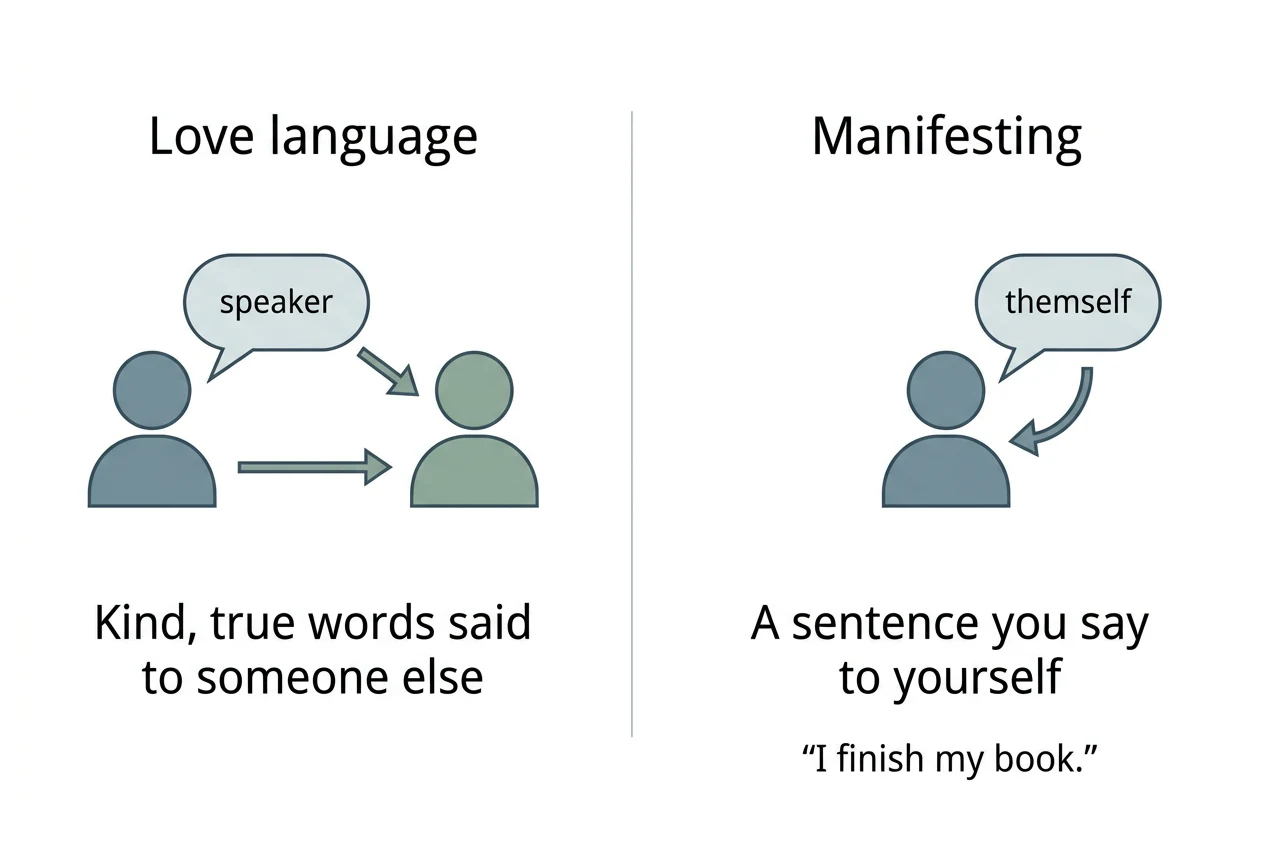
The first is a love language. It's one of the five Gary Chapman described, and it means kind, true words said to someone else. That has its own post.
The second is this post. A sentence you say to yourself. In manifesting it usually names what you want, in the present tense: "I finish my book." "Thank you for my studio."
Psychologists use the word more narrowly. In a 2014 review, Geoffrey Cohen and David Sherman wrote that self-affirmation interventions "typically have people write about core personal values". Writing about what matters to you is not the same as repeating a wish. The research treats them differently, and so should you.
What the research says about repeating a line
Start with the bad news, because it changes how you write.
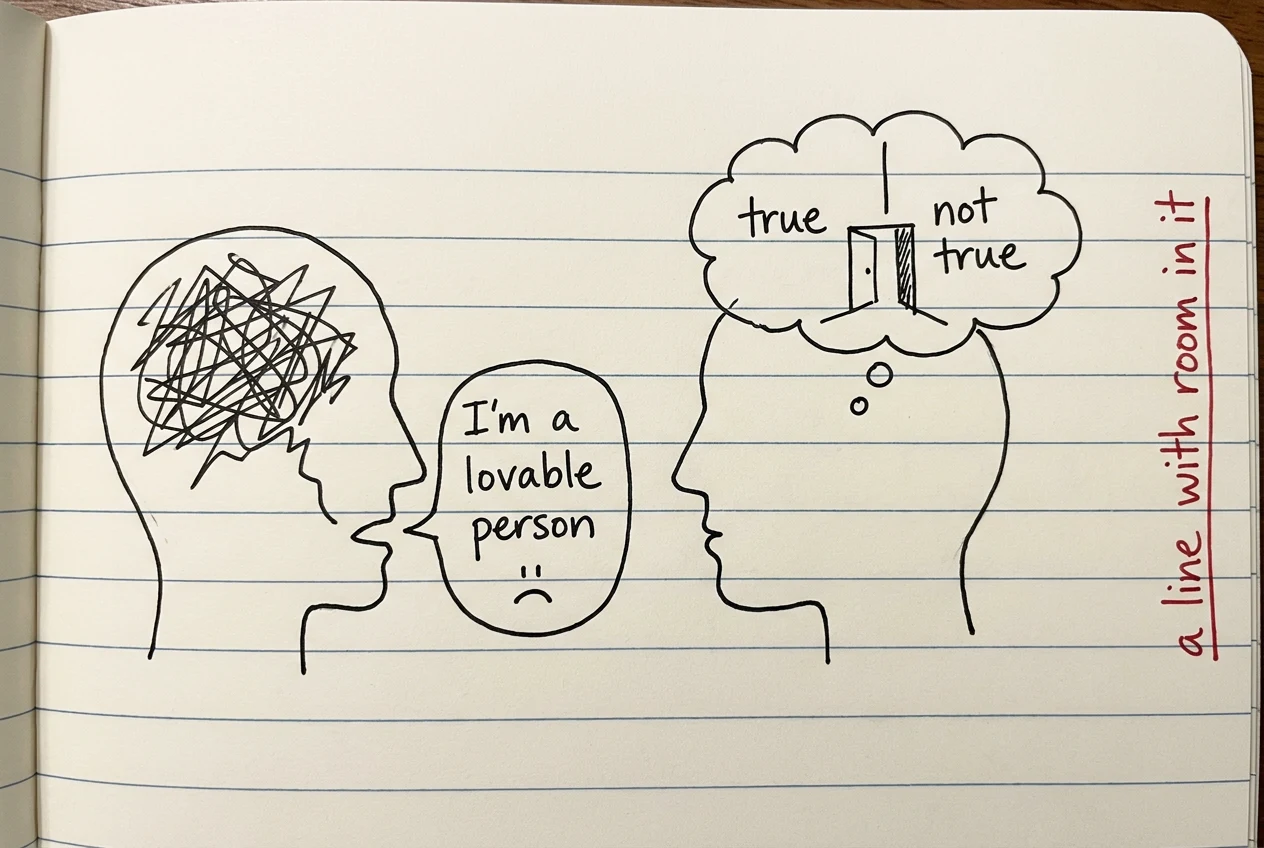
In 2009, Joanne Wood and two colleagues ran experiments on positive self-statements. People with low self-esteem who repeated "I'm a lovable person" felt worse than those who didn't. People with high self-esteem felt better, but only "to a limited degree". Their conclusion was blunt: repeating these statements "may benefit certain people, but backfire for the very people who 'need' them the most."
One detail is useful. The low self-esteem group did better when they thought about how the statement was both true and not true, rather than how true it was.
So a line you argue with in your head isn't working. A line with room in it can.
Where "as if it's already yours" goes wrong
Many manifesting routines tell you to word the line as if it's already done. That deserves a careful look.
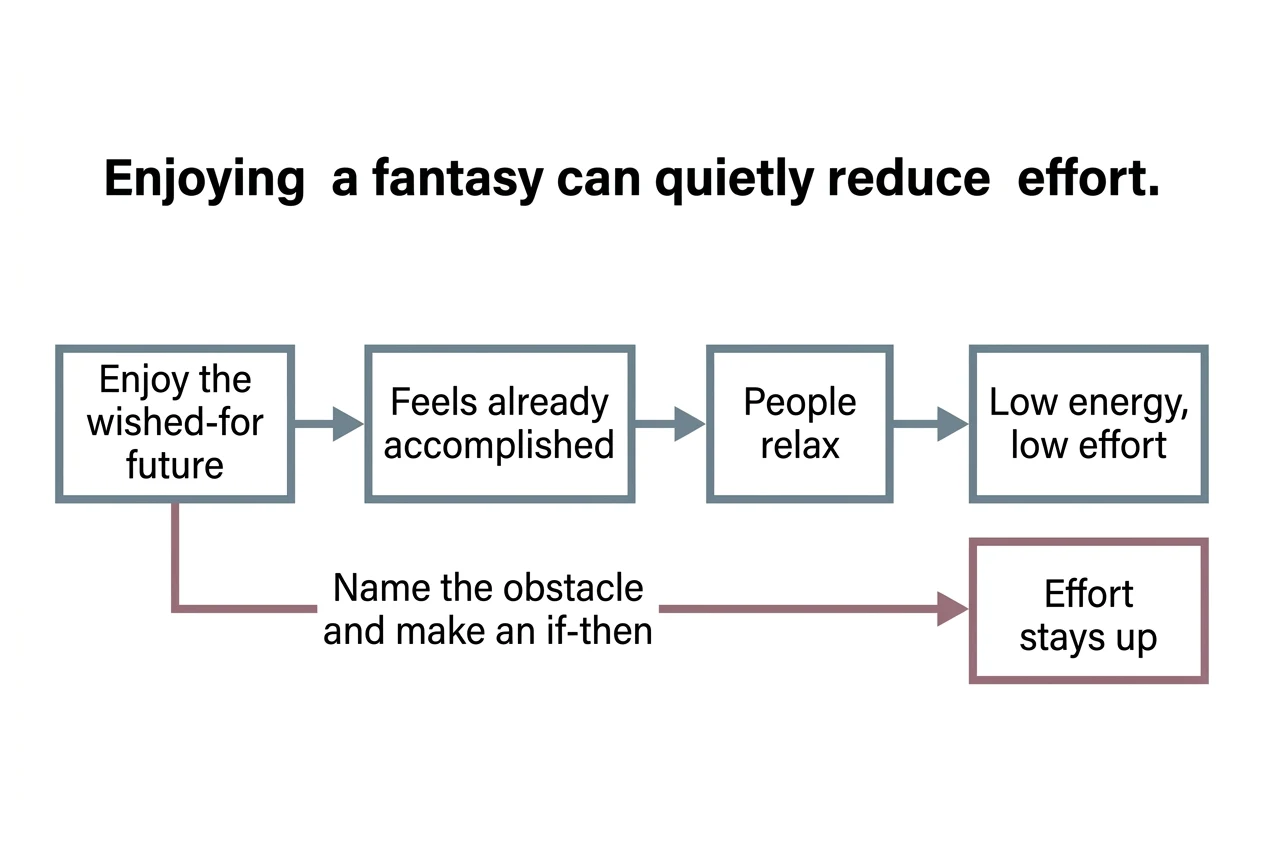
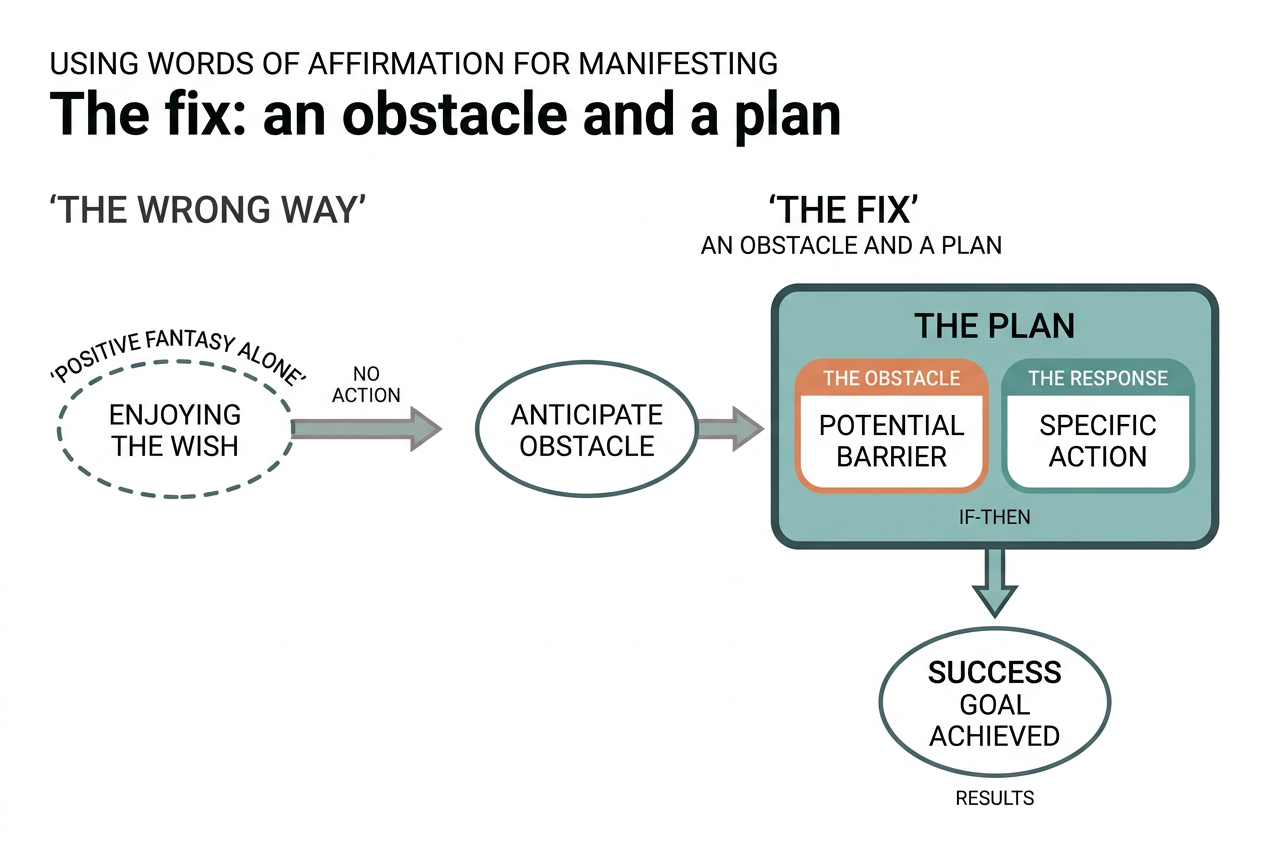
Gabriele Oettingen has studied this for years. In a 2019 chapter with Peter Gollwitzer, she describes what happens when people indulge in positive fantasies about a wished-for future. It helps people feel accomplished and happy. "At the same time, it hurts people with implementing the wished-for future. It leads to low energy, low effort, and little success."
Why? Because such fantasies "can suggest to people that the desired future is already accomplished". People relax. In one study, women in a diet programme who imagined success most positively lost fewer pounds after 3 months and after 1 year.
Here is my reading, and it's only that. An affirmation worded as already done may work the same way if all you do is enjoy it. The studies were about fantasies, not affirmation lines. But the risk is the same, and it's cheap to guard against.
The fix: an obstacle and a plan
The same research points to two additions.
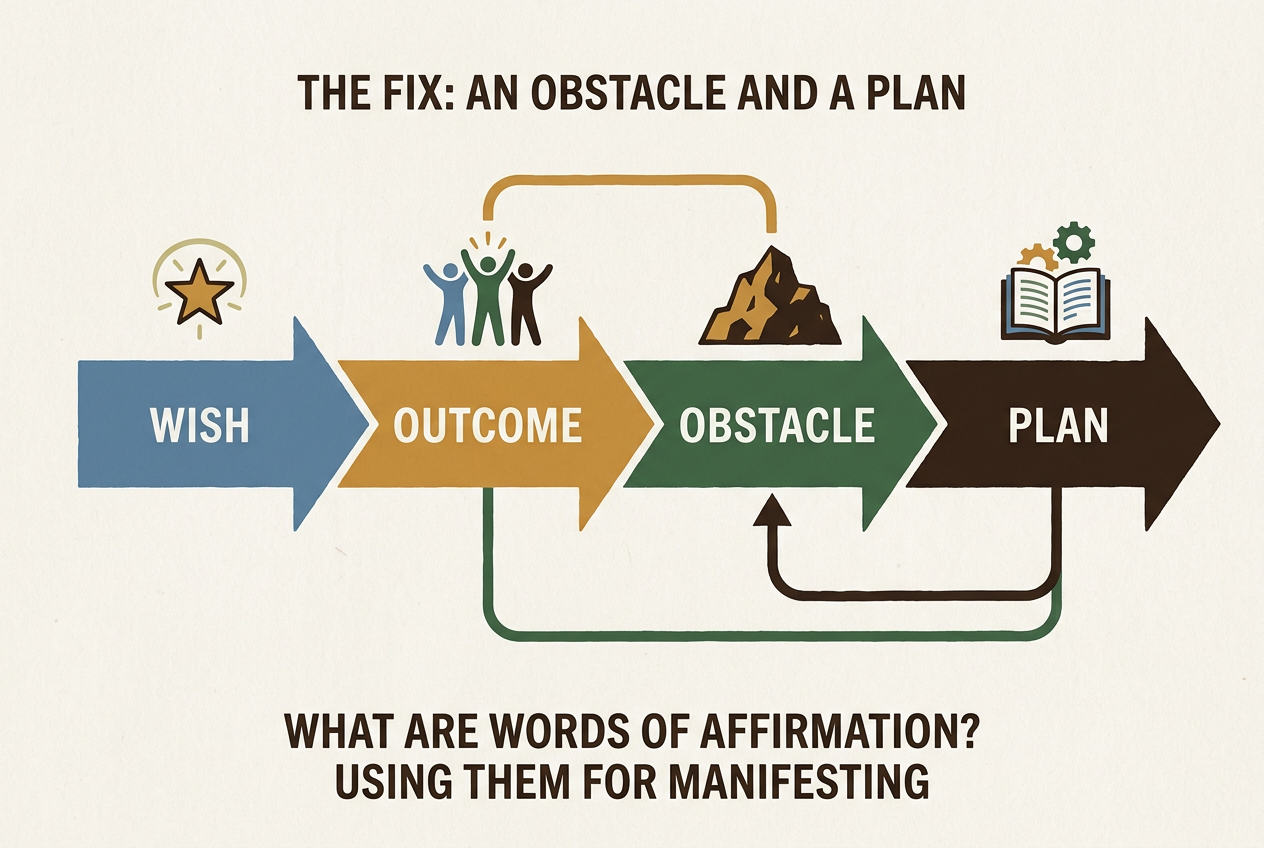
The first is mental contrasting. You keep the wish, then set it beside what could get in the way. The chapter says people who do this "understand what they want and can achieve, and take the necessary steps".
The second is an if-then plan. Gollwitzer and Sheeran describe these as plans that link a moment to a response: if this happens, then I will do that. Across 94 studies, forming one had a "medium-to-large effect" on reaching goals.
Oettingen's team packed both into a method called WOOP: Wish, Outcome, Obstacle, Plan. Their line for why: "dreamers are not often doers."
None of this tests whether the universe grants a wish. It tests what people do. Psychology Today defines manifestation as turning an idea into a reality, and says actions are a key part of it. That's the honest version.
How to write words of affirmation for manifesting
Five steps.
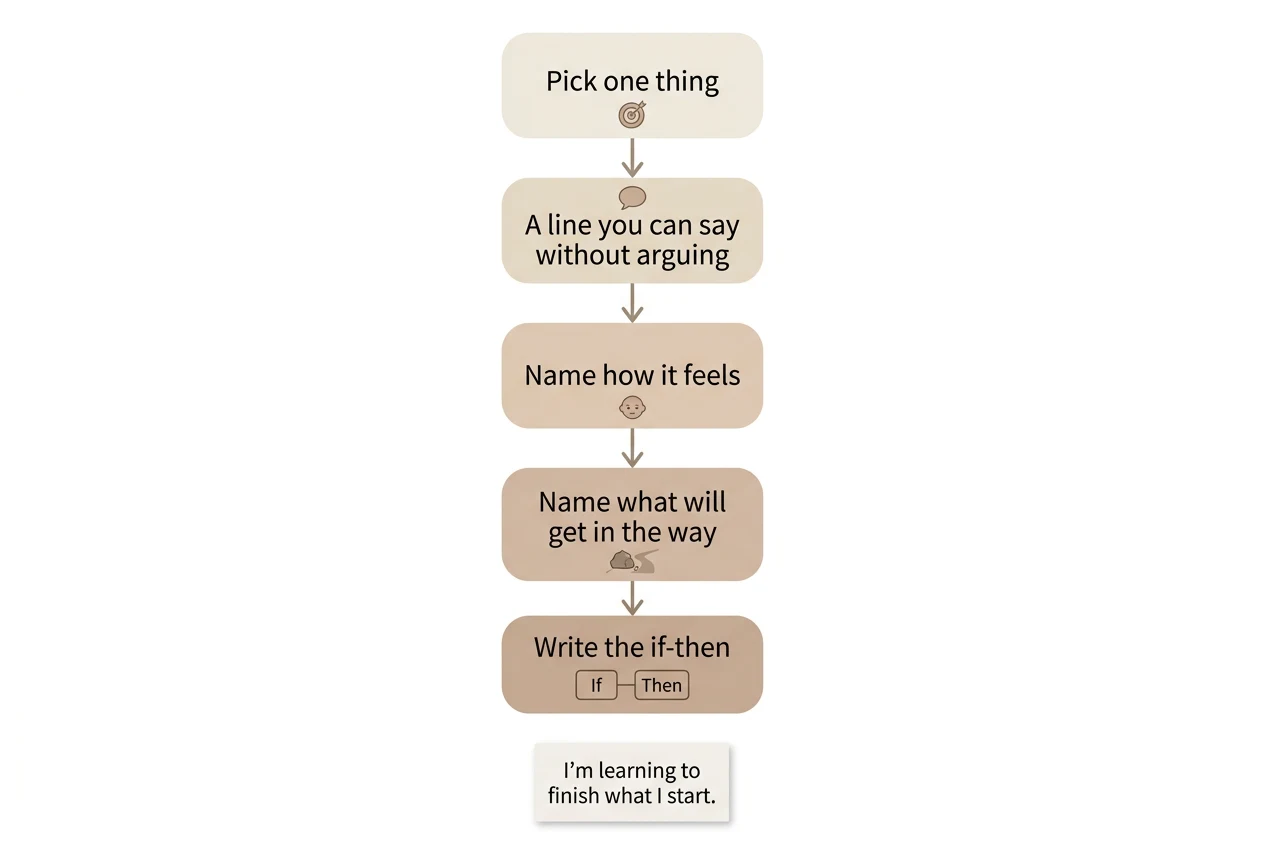
- Pick one thing. Specific, and possible. WOOP asks for a wish that's "somewhat challenging, but you should be able to fulfill it."
- Write a line you can say without arguing. If "I am" makes you flinch, try "I'm building" or "I'm learning to". Leave room for the part that isn't true yet.
- Name how it feels. Three words is enough. Settled, say. Or unhurried.
- Name what will get in the way. Something inside you, not the weather. I forget. Or I talk myself out of it.
- Write the if-then. "If I lose momentum after a few days, then I write my line three times."
Then say it on a rhythm. You've probably heard of 3, 6 and 9 times a day. The research above says nothing about those numbers, so treat them as a habit to hang the practice on, not a rule.
Three lines that leave room:
- "I'm learning to finish what I start."
- "I'm building the studio one week at a time."
- "I keep my word to myself, even on the slow days."
Doing it in Manifest
Manifest asks for these steps in order. Start on the start page and it walks you through five screens.
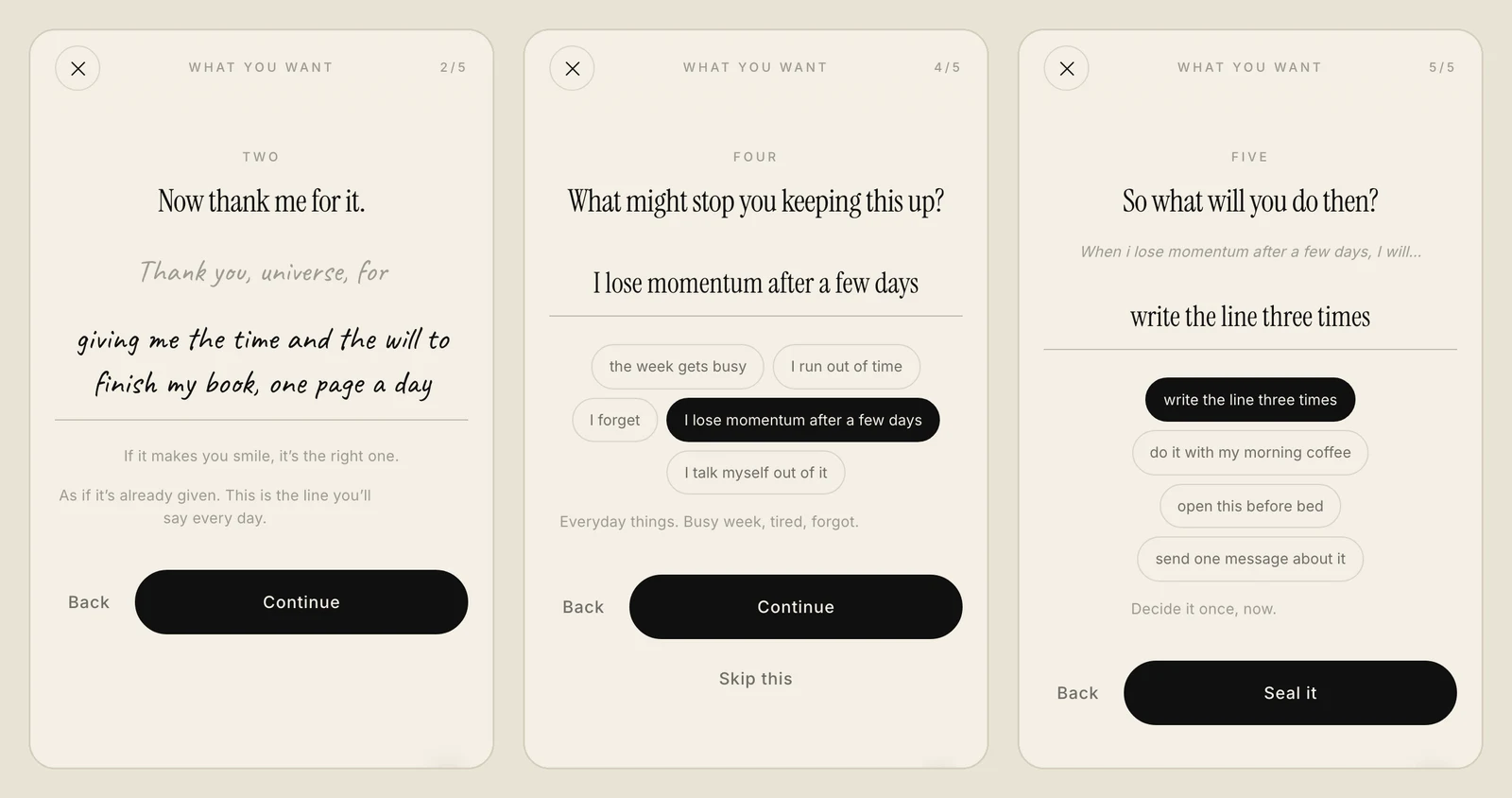
Step one asks "Tell me what you want", and says "One thing. Be specific." Step two is the line. It's worded as thanks, "Thank you, universe, for", and the screen says "As if it's already given. This is the line you'll say every day." That's the app's framing. Whether it suits you is your call.
Step three asks for three words: how it feels. Then comes the part the research cares about. Step four asks "What might stop you keeping this up?" and offers everyday answers such as "I forget". Step five asks "So what will you do then?" and finishes the sentence "When I forget, I will…" The app doesn't call it WOOP. But steps four and five ask for much the same two things: the obstacle and the if-then plan.
Don't skip them. If the line is the fantasy, those two screens keep it honest.
Away from the phone, the same five questions are on a free intention worksheet, with two if-then cards to cut out and keep.
After that, there's more to explore. The 369 page holds your one sentence and reads "Three, six, nine times a day." The meditate page has a timer from 3 to 30 minutes and keeps playing with the screen off, so you can sit with your line there. The you page asks "What's moving?" Use it to notice, not to prove. If you'd rather write by hand, the 369 journal and the 66-day journal are free to print, and so is the short guide How to Manifest.
It's a place to practise. Not a promise that anything will change.
When a line stops fitting
Sometimes a line makes you feel worse. Take that seriously. It's what Wood's low self-esteem group found. Soften the wording, or change the line.
Sometimes a want stops being yours. That happens. A flame sits on every tab page — drag it where you like, tap it to burn something — and the burn feature is for exactly that.
And if the words keep hurting, or low moods stay long, talk to someone who can help. A line on a phone can sit beside that. It can't replace it.
Pick one thing. Write a line you can believe, and the if-then that goes with it. Start today.