Words of affirmation are one of the five love languages: saying kind, true things out loud or in writing, so the other person feels seen. The words matter less than whether they're specific, and whether you mean them.
In short: Words of affirmation means telling someone, plainly and truthfully, what you value in them. Say it specifically, at a moment they can take it in, and never as a lever to get something.
The five love languages
Gary Chapman, a Baptist pastor and marriage counsellor, put the idea in a book in 1992, The 5 Love Languages. His claim was simple. People give and receive love in different ways, and most of us give it the way we'd like to get it. Then we wonder why it doesn't land.
He named five ways of showing love. Cleveland Clinic and Psychology Today describe them in much the same way:
- Words of affirmation: saying supportive things. A compliment, a thank you, "I'm proud of you."
- Quality time: giving someone your full attention. A walk without phones, a date night, a proper conversation.
- Receiving gifts: something that says "I was thinking of you." It can be small, like a favourite snack or a handwritten letter.
- Acts of service: helping through what you do. A chore taken off their plate, a coffee brought over, an errand run when they're busy or ill.
- Physical touch: closeness you can feel. A hug, holding hands, sitting close.
Chapman's idea is that one of these tends to land harder than the others for a given person. This post is about the first.
What words of affirmation are
Of the five, words of affirmation is the one that runs on language. A compliment. A thank you. "I'm proud of you." A note left on the kitchen counter.
For someone whose language this is, a kind sentence can carry more than a gift. The other side is worth knowing too. Harsh words, a sharp tone or a thoughtless joke can stay with them for days. They replay it. They wonder what they did.
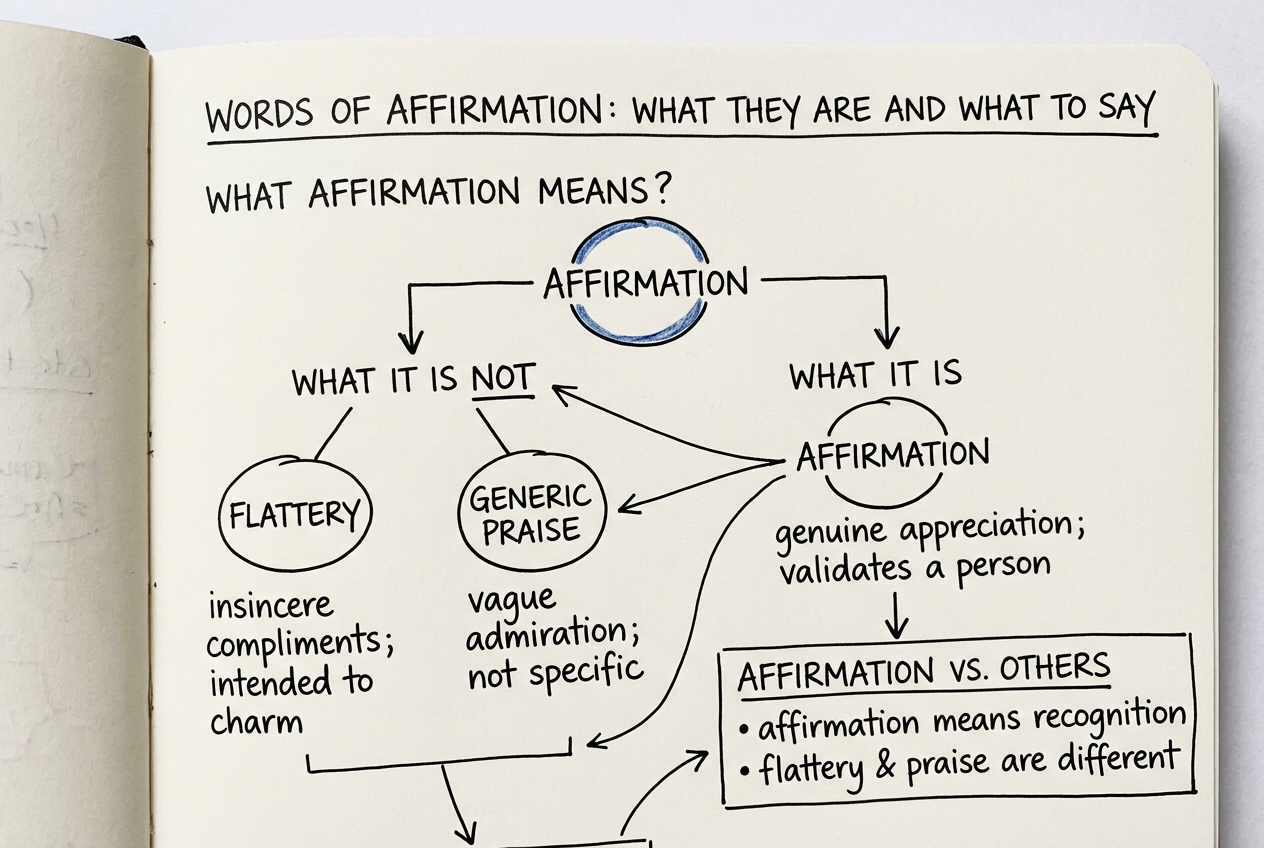
What affirmation means?
To affirm something is to say it is true. That's the whole trick.
Affirmation isn't flattery, which says what someone wants to hear. It isn't a generic "you're amazing" either. Compliments that are robotic, repeated or too broad tend to sound like nothing, and people can tell.
An affirmation points at something real. You noticed it, so you say it. "You stayed calm when the train was cancelled, and it made the whole evening easier." That's affirmation. "You're the best" is a greeting card.
How to do it?
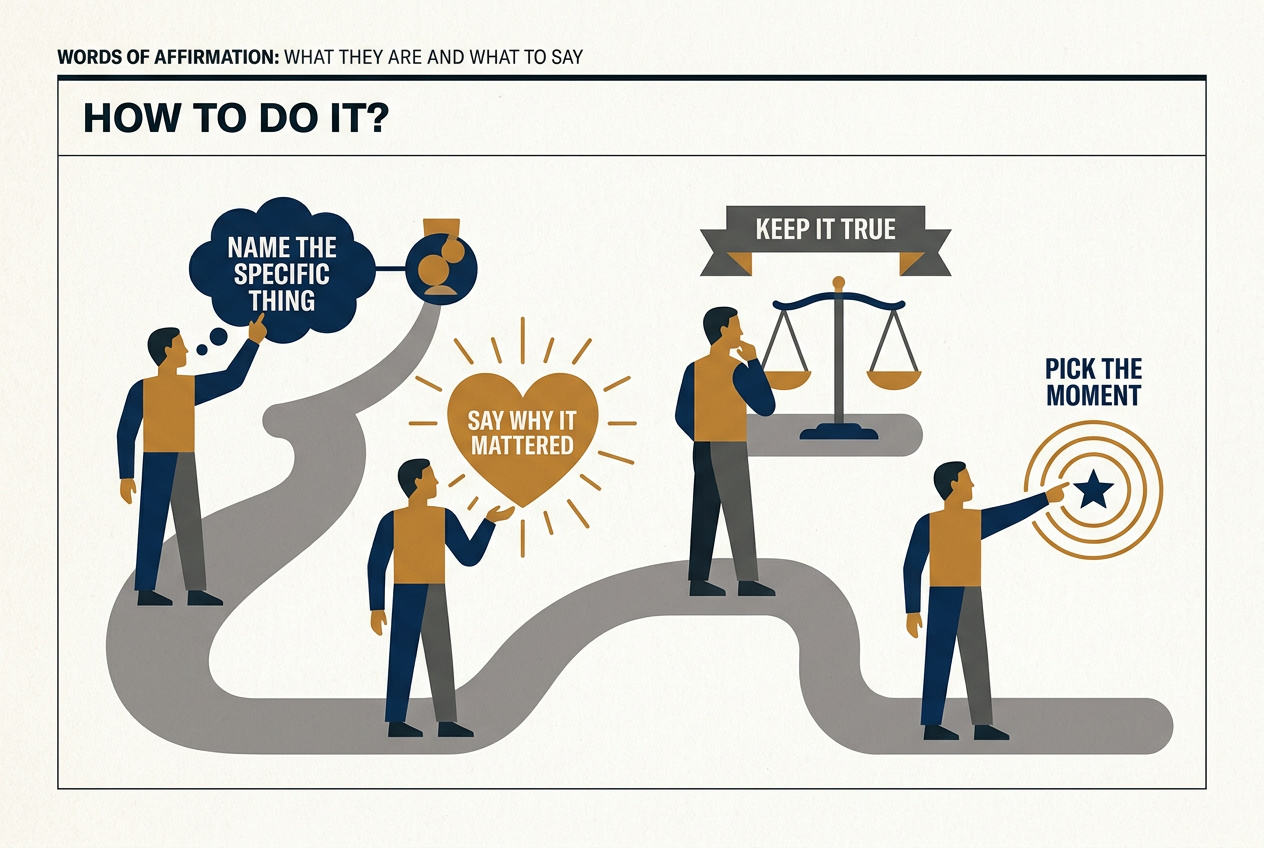
Start with the specific thing. Vague praise gives the person nothing to hold. Name what they did or who they were in that moment.
Then say why it mattered, in one sentence. "You called your mum back even though you were tired. I love that about you."
Some things help:
- Praise the person, not only the result. Effort and character last longer than outcomes.
- Say it with your face and voice, or put it in writing. A text they can reread does more than a passing remark, for some people.
- Keep it true. If you don't believe it, they will hear that.
- Ask, don't demand. If you'd like more words from someone, tell them so as a request. "It would mean a lot if you told me when I've done something well" is a request. "You never say anything nice" is a complaint, and it lands like one.
- Learn to take a compliment yourself. Deflecting theirs teaches them to stop.
If you don't know whether this is someone's language, watch what they do for others. People often give love the way they'd like to receive it. The friend who is always writing long, warm messages is probably hoping to get a few back.
When to do it?
Every day is a fair aim. One sincere thing a day, not a speech. Calm's guide suggests at least one sincere compliment daily, and that's small enough to keep up.
Some moments earn more than others:
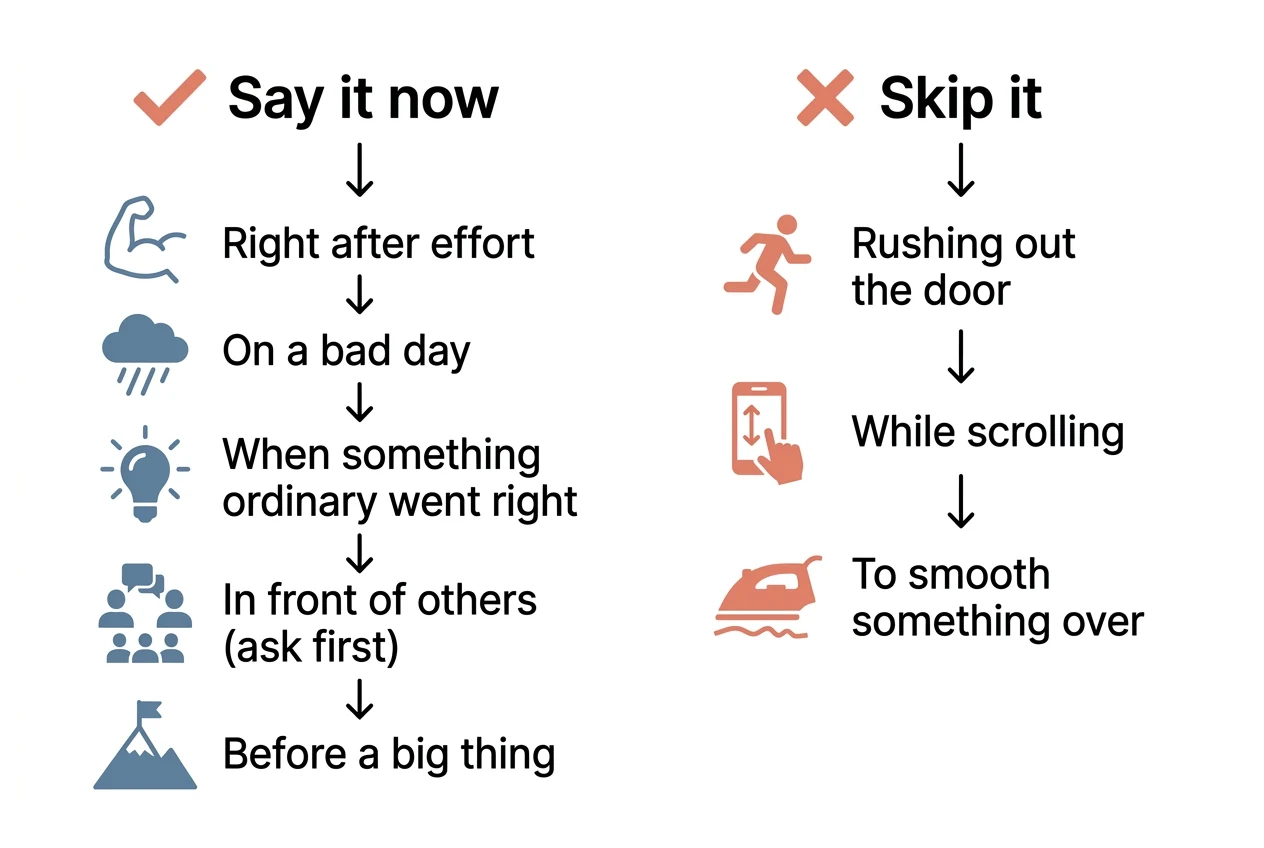
- Right after effort. When they finished the hard task, not a week later.
- On a bad day. When they're doubting themselves, a true sentence is worth a lot.
- When something ordinary went right. Nobody thanks the person who always remembers the bins.
- In front of others, if they'd like it. Ask first. Some people hate being praised in a room.
- Before a big thing. "I've watched you prepare for this. You know it."
And a few moments to skip. Don't say it while you're rushing out the door, or while you're scrolling. Choose a moment when they can actually take it in.
Never use it to smooth something over. Sweet words followed by "if you loved me, you'd understand" is manipulation, not affirmation. The same goes for pouring on praise early in a relationship to win someone over.
Words of affirmation you can say today
Take these as starting points and change them until they sound like you. Better still, add the detail that only you know.
Thanks:
- "Thank you for making dinner. I know today was long."
- "I noticed you fixed that without being asked. Thank you."
- "I'm grateful you're in my life."
Noticing:
- "You're really good at explaining things. I always understand after you've talked me through it."
- "I love how you think of other people first."
- "You look great today."
Pride and encouragement:
- "I'm proud of you."
- "You handled that so well."
- "I believe in you."
- "You're stronger than you think."
- "I admire how you keep going."
Love and belonging:
- "I love you."
- "I'm so glad it's you."
- "You mean a lot to me."
- "I'm here, whatever happens."
Hard days:
- "That sounds really hard. It makes sense you feel this way."
- "You don't have to fix it tonight."
- "I'm on your side."
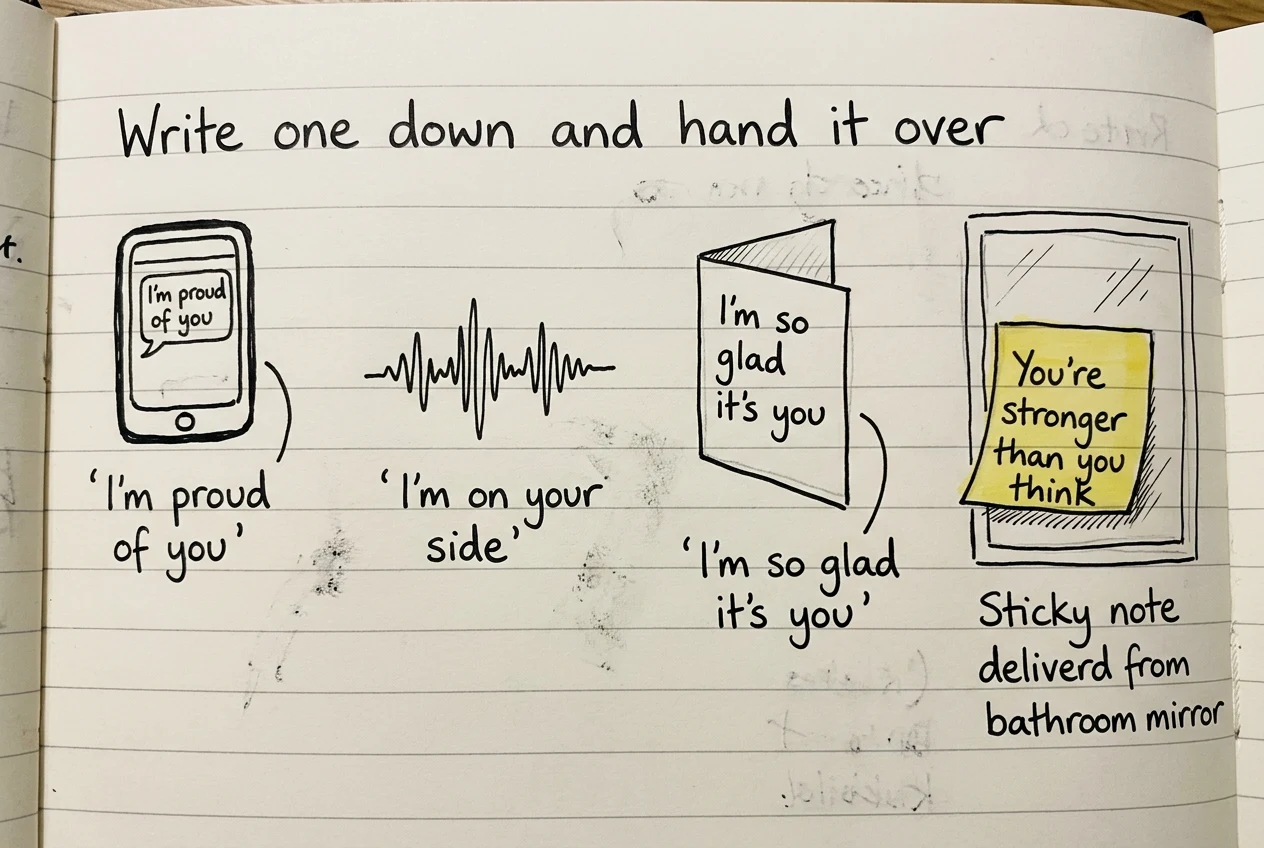
These work in a text, a voice note, a card, a sticky note on the mirror. Write one down and hand it over. It counts.
They also work outside romance. A friend, a parent, a colleague who covered for you. Chapman's ideas began with couples, but a true kind sentence isn't reserved for them.
Saying it to yourself
Everything above is about what you say to someone else. The same habit works pointed inward, and most people skip it. Simply Psychology counts self-affirmation as part of this language too: a voice note, a page in a journal, a line said to the mirror.
Manifest, the quiet app on this site, has a small place for each of those. It's a way to practise, not a promise that anything will change.
Write it. The Today screen asks one question: "What do you want?" Answer with one thing. Then write the sentence you'd say to a friend in your position, plain and true. "I'm someone who finishes what I start" beats "I will be a huge success."
Sit with it. The meditate page runs a timer at 3, 5, 10, 15, 20 or 30 minutes, with five background sounds. It keeps playing with the screen off. Say your sentence slowly, or just hold it. Three minutes is a fair start.
Notice it. The you page asks "What's moving?" and offers small examples: "A reply. A number. A morning that felt like it." That's affirmation again, aimed at something real you noticed. It's your own record, kept on your phone. It isn't evidence of anything, and there's no leaderboard.
Keep it on paper. If a phone isn't where you want this, two of the free printables suit it: a pocket book of thank-yous, three a day for three weeks, and a 66-day journal with a page for each day.
What the research says
It's fair to be honest about this. The five love languages are popular, and the science behind them is thin.
A 2017 study of 67 couples in the journal Personal Relationships found only limited evidence that partners who shared a love language were happier. A 2023 review concluded that research doesn't confirm people reliably have one preferred love language, or that couples who match have better relationships.
So don't treat it as a personality test. Treat it as a reminder. Most people like being told what they do well, and most of us say it far less than we think.
You can start small. Pick one person. Find one true thing. Say it today. If that person is you, start with one thing.