If you're wondering how to let go of something you keep replaying, start by getting it out of your head and onto a page. Then get rid of the page. It sounds too small to matter. Some research suggests otherwise.
In short: Write the memory down, then destroy the page. A few studies suggest that can loosen a thought's grip. Manifest's Let it go screen does it with a burn. It's a ritual, not a cure.
What can't you let go of?
Almost anything can stick. The usual ones:
- The conversation you keep replaying, and the thing you should have said.
- Someone who left, or someone you left.
- A mistake that's long over for everyone except you.
- The way something ended.
- A version of you, or a life you were sure you'd have.
- Words someone said years ago that you can still hear.
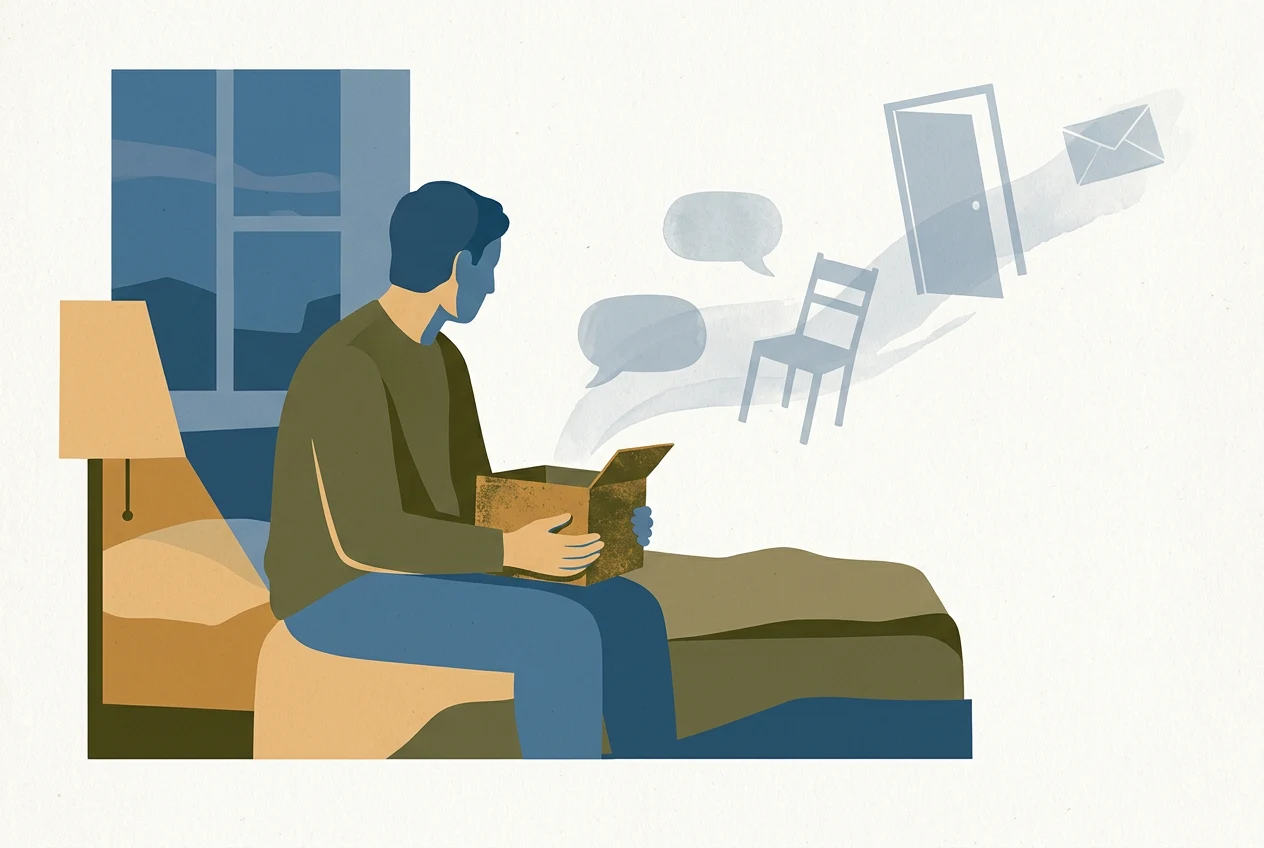
Some of these are small and some are heavy. The memory doesn't check which. Nothing is wrong with you for still holding it.
Why it won't leave
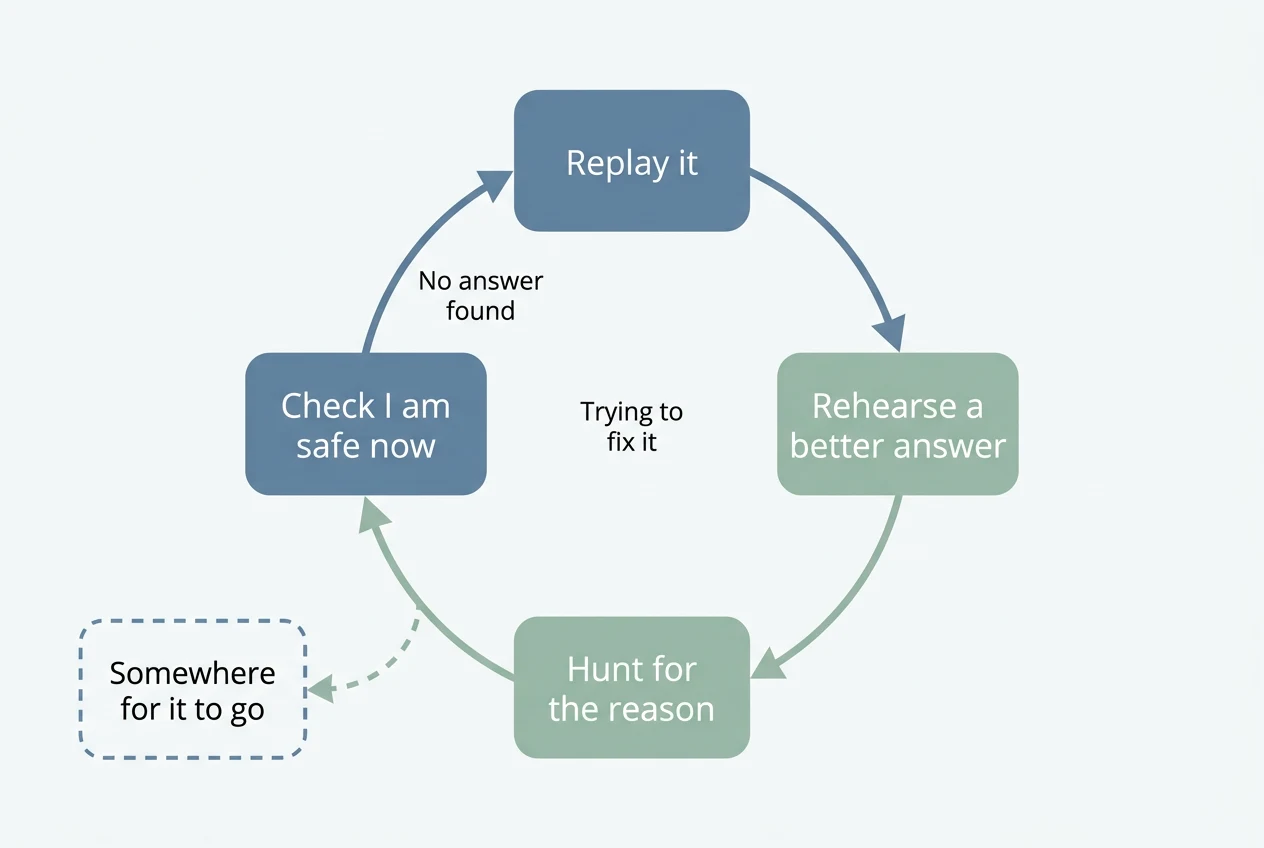
Your mind replays it because it's trying to fix it. It rehearses the better answer. It hunts for the reason. It checks whether you're safe now. Psychology Today describes this as giving you a sense of control, or a feeling you're working toward a solution, and adds that we rarely find one.
So the loop starts again. Perfectionism can feed it, and so can a fear of uncertainty. So can a low opinion of yourself, when your mind treats every old mistake as proof.
Telling yourself to stop doesn't help much, because "stop thinking about it" is a thought about it. The loop needs somewhere to go.
How to let go: write it down, then end the page
The idea is to give the memory a body. Right now it lives inside your head, where it can run all night. On paper it's a few lines with an edge, and you can do something to it.
Here's the whole method:
- Name one thing. Not your whole history. One memory, in plain words, the way you'd say it to yourself at 2am.
- Put it on paper. Write what happened, or the sentence you keep repeating, or what you wish you'd said.
- End the page. Tear it, shred it, or burn it. If you use real fire, do it outside, in a metal bowl, with water close.
- Let whatever comes come. Relief, tears, nothing at all. Don't grade it.
That's it. It's a small ritual, and small is the point. You're not solving the memory. You're giving it an ending.
What the research says, and what it doesn't
Two studies come close to this idea.
In 2013, Pablo Briñol and colleagues had students write down thoughts, then either throw the paper away or keep it. The students who threw the paper away were less influenced by those thoughts afterwards. Students who kept it safe in a pocket or wallet were more influenced than those who left it on a desk.
In 2024, a Japanese team published a study in Scientific Reports. In the first experiment, 50 students were insulted after writing an essay, then wrote out every thought about it. Those who crumpled the paper into a bin saw their anger fall back to where it started. Those who put it in a folder stayed angry. A second experiment, with 46 adults and a shredder, found the same.
The authors call their explanation backward magical contagion: a sense that what happens to the paper happens to the thing it stands for.
Now the limits, because they matter. Both studies were about judgements and anger, not grief or an old heartbreak. The 2024 participants were all Japanese, the effect was measured straight away, and burning wasn't tested. And Briñol's team is clear that the thoughts are "not really gone". You can bring them back.
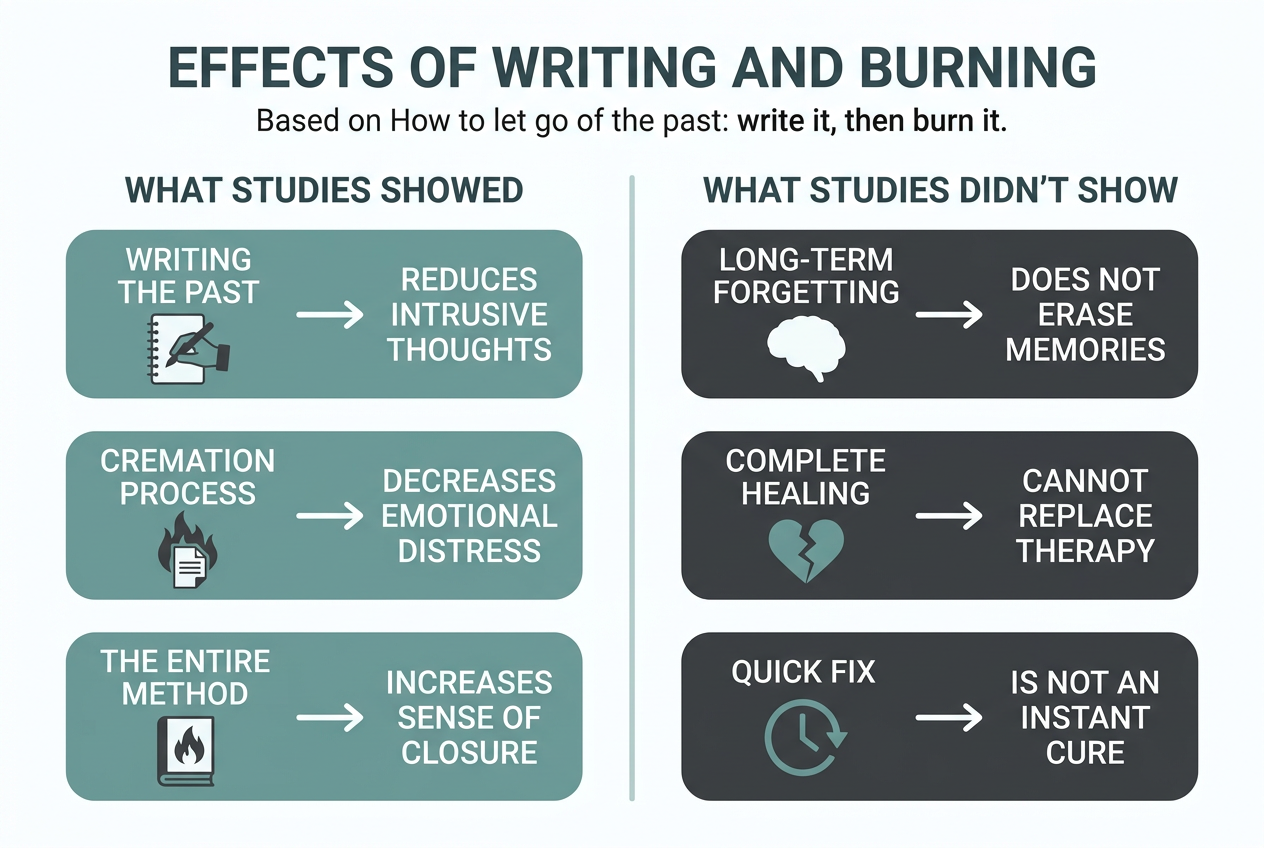
Nothing here proves that burning a page heals anything. It's a reasonable thing to try, with a small amount of evidence behind why it might help.
The Let it go screen, step by step
Manifest has this ritual built in, on its Let it go page. Here's what happens.
1. Choose how to write it. The first screen reads "Write it. Burn it." with the line "No match, no sink" under it. That reads like a promise of nothing to light and nothing to clean up. You get two options: "Write it here", typed and then shown as handwriting, or "Photograph your paper", where the screen says to burn the real one. At the bottom: "Never saved, never uploaded."
2. Write what you're letting go of. The screen asks "What are you letting go of?" Type it. It appears in handwriting as you go, with the note "Nobody reads this. The words aren't saved." Then tap "Put it on paper."
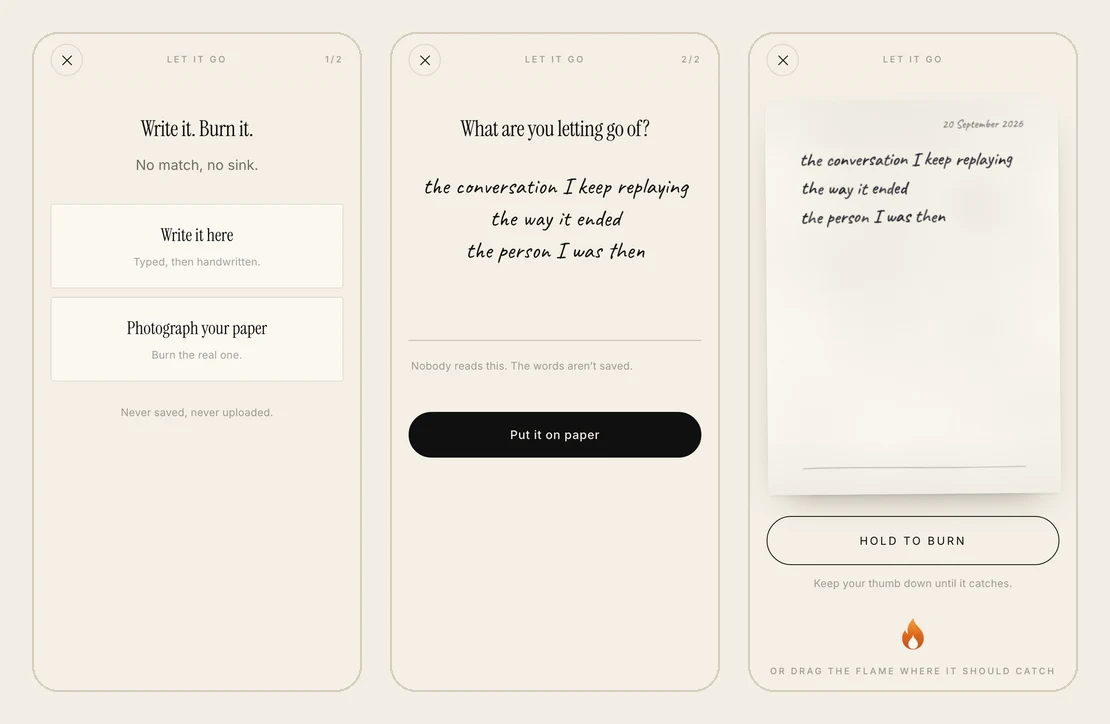
3. Hold to burn. Your words land on a sheet of paper dated today. The button says "Hold to burn" and the line under it says "Keep your thumb down until it catches." A bar fills as you hold. Or you can drag the flame to the spot where the fire should start.
4. Watch it go. The paper catches from the bottom and burns upward, the edges glowing, until it's sparks and then nothing. Your writing is the last thing to go. While it burns, the screen offers "Drop another", with the words "Let it go."
5. It's gone. The last screen says "It's gone. Not yours to carry." A small counter reads "1 thing released", and a Done button closes it.
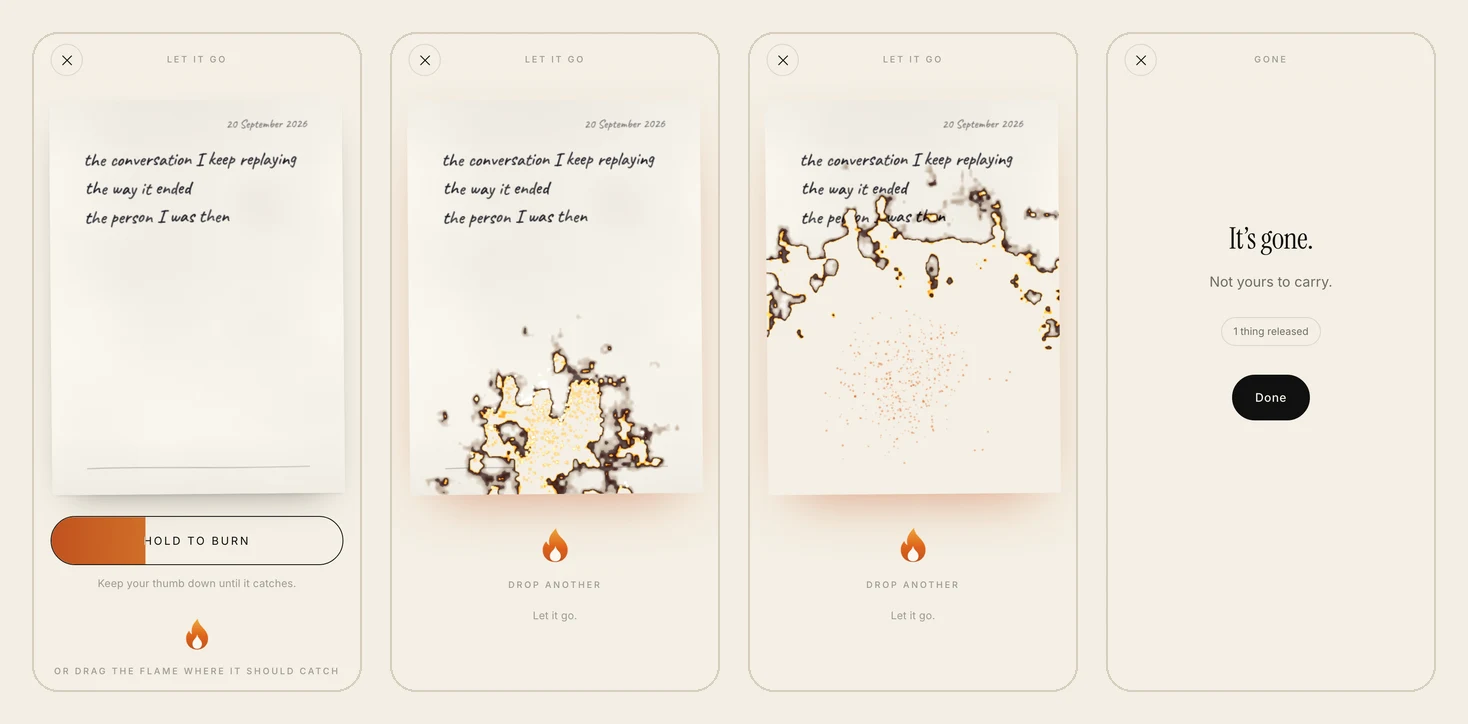
If you have more than one thing, burn more than one, a memory per page. The counter goes up as you do: the second time it read "2 things released".
A few tips for what to write. Be specific. "The argument on the stairs in March" gives the loop less to hold than "everything about him". Write the sentence you keep repeating. Write what you never said. You're the only reader, and the page won't be kept.
When the fire's out, there's no rule about what comes next. If you'd like a slow ending, the meditate page has a 3-minute timer.
Some people would rather do this on real paper. The free let-it-go pages are the same ritual, printed: write the thing down, then tear the page up, or burn it a small piece at a time in a fireproof bowl with water nearby.
When it comes back
It might. One burn isn't a verdict. Memories return, especially on tired days, and that doesn't mean you did it wrong.
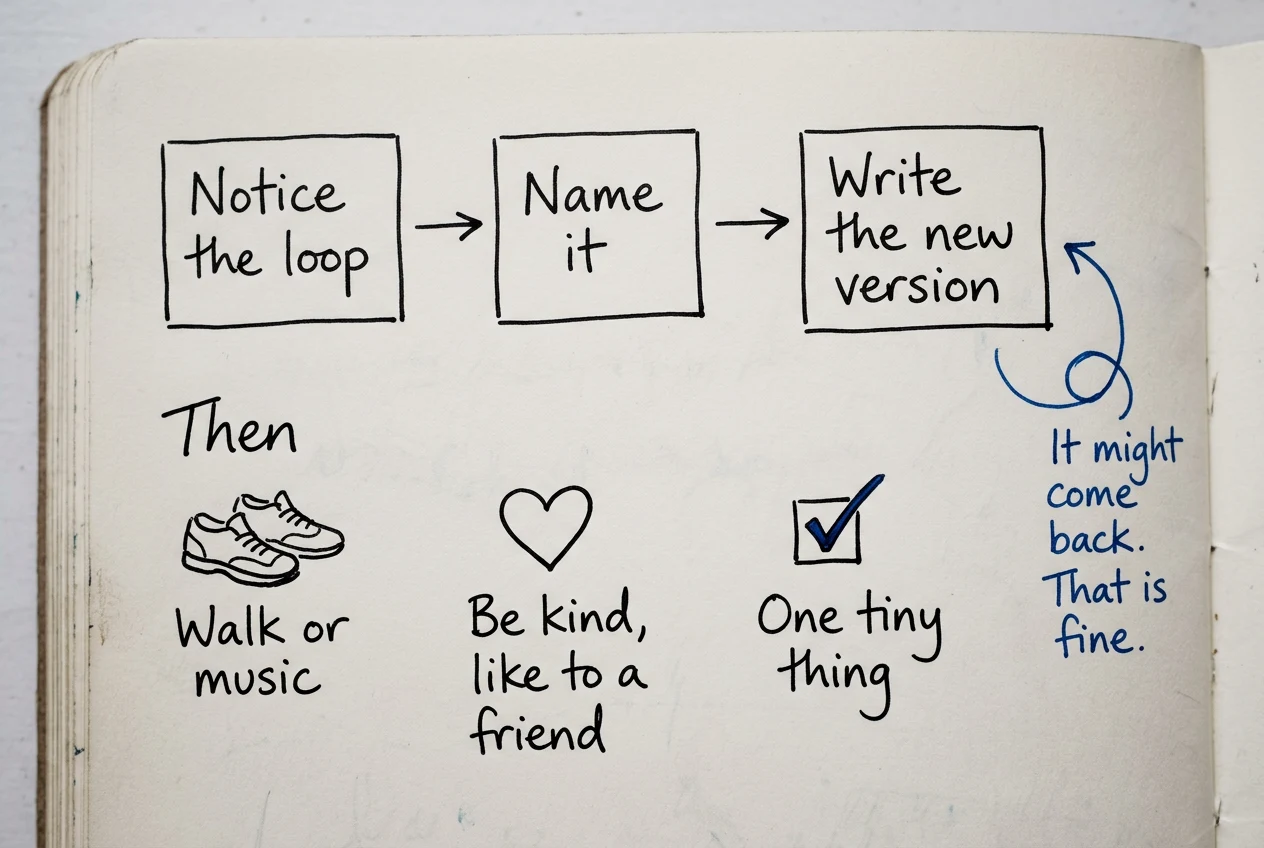
When it does, don't scold yourself. Notice the loop, name it, and write the new version. Do it again if you want to.
Psychology Today's other suggestions are simple and worth borrowing. Interrupt the loop with something physical, like a walk or music. Be as kind to yourself as you'd be to a friend. If you're not sure what to say, the post on words of affirmation has lines you can turn towards yourself. Then pick one thing you can actually do, even a tiny one, and do that.
When to ask for more than a ritual
If the replaying is costing you sleep, or you can't get through the day, or the memory is tied to a loss or something frightening, a ritual won't be enough on its own. Psychology Today notes that brooding of this kind can lead to depression, anxiety and insomnia, and it points to therapy, including cognitive behavioural and mindfulness-based approaches. A burn on your phone is a companion for that work, not a replacement.
Pick one thing. Write it plainly. Put it down.