The best manifesting quotes are short, checked against where they came from, and used once a day instead of scrolled past. Here are five, with their sources, and a five-minute routine for turning one of them into a habit.
In short: Pick one quote, write it by hand, add one action it points to, and read it again each morning. Five real, sourced lines are below, and two famous ones turn out to be misattributed.
Why most manifesting quotes do nothing
You've seen the picture. A sunrise and a cursive font, with a promise about the universe. You like it, you scroll on, and by lunch it's gone.
A quote doesn't do much on its own. What it can do is give you one sentence to come back to, on the same day, at the same time, until it starts to sound like something you said. That's a small job, and it's enough.
If you want the longer explanation of what manifesting is and what the research does and doesn't support, the power of manifesting covers it. This post is only about the lines.

Five manifesting quotes, and where they come from
Several of the best-known lines online are pinned on the wrong person. So each one below comes with its source, and where the name you've seen is wrong, I say so. Ford is one of them, sort of.
W. H. Murray: until one is committed
"Until one is committed there is hesitancy, the chance to draw back, always ineffectiveness."
W. H. Murray, The Scottish Himalayan Expedition (1951)
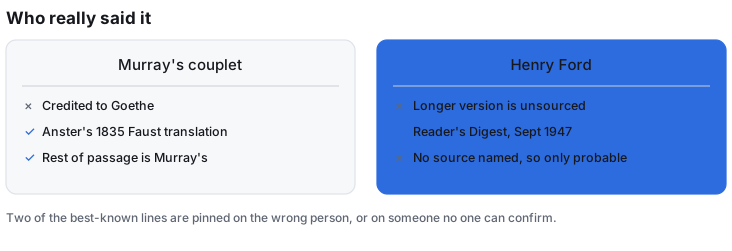
Murray was a mountaineer, and this opens a passage about the moment a plan stops being an idea and becomes something you've signed up for, with no easy way back. Short version: commitment. It's often shared with the couplet that follows it, "Whatever you can do, or dream you can, begin it. Boldness has genius, power, and magic in it", credited to Goethe. Murray himself credited that couplet to Goethe, but Quote Investigator found it comes from John Anster's free translation of Faust, published in 1835, and not from Goethe's own words. The rest of the passage is Murray's.
What it asks of you: decide, then begin. The hesitating is the part that costs you.
Marcus Aurelius: the soul is dyed by its thoughts
"Such as are thy habitual thoughts, such also will be the character of thy mind; for the soul is dyed by the thoughts."
Marcus Aurelius, Meditations, Book Five, translated by George Long
This is the quote to reach for if you'd rather not claim that thoughts bend the world. It makes a smaller claim, and a safer one: what you think over and over shapes the mind doing the thinking. You can read it in Long's translation.
What it asks of you: watch which thought you rehearse most. Then choose one on purpose.
Mark's Gospel: believe that you have received it
"Therefore I tell you, whatever you ask in prayer, believe that you have received it, and it will be yours."
Mark 11:24, English Standard Version
Many manifesting lists lean on this verse, and it's easy to see why, since the words "believe that you have received it" sound a lot like "live like it's already yours." It's a line about prayer, though, and it comes from a faith with its own meaning for it, so read it in that setting. The verse is on Bible Hub if you want the context around it.
If you share the faith, it may be the line you want. If you don't, it's still a fair picture of what the practice asks: to hold the thing as settled, and to stop checking every hour whether it has moved.
What it asks of you: act today as if you had been heard.
Henry Ford, probably: you are right either way
"Whether you believe you can do a thing or not, you are right."
Attributed to Henry Ford, The Reader's Digest, September 1947
The line you've seen is usually longer and chattier, with "think you can" and "think you can't". The earliest match Quote Investigator located is shorter, as above. It ran in September 1947, a few months after Ford died in April of that year, and the magazine named no source. So treat Ford as the likely author, not a certain one.
It's a line about belief and effort, and it doesn't promise a result. Someone who expects to fail often doesn't try, which proves them right.
What it asks of you: notice where you've already decided you can't.
Say it in your own words
The fifth quote should be one you wrote. Take any line above and put it in the present tense, about one thing you want. "I'm someone who begins." "I'm learning to expect that I can." The words of affirmation guide is about what makes a line sound true instead of forced, and that matters more here than who said it first.
A quote you find online might not be theirs
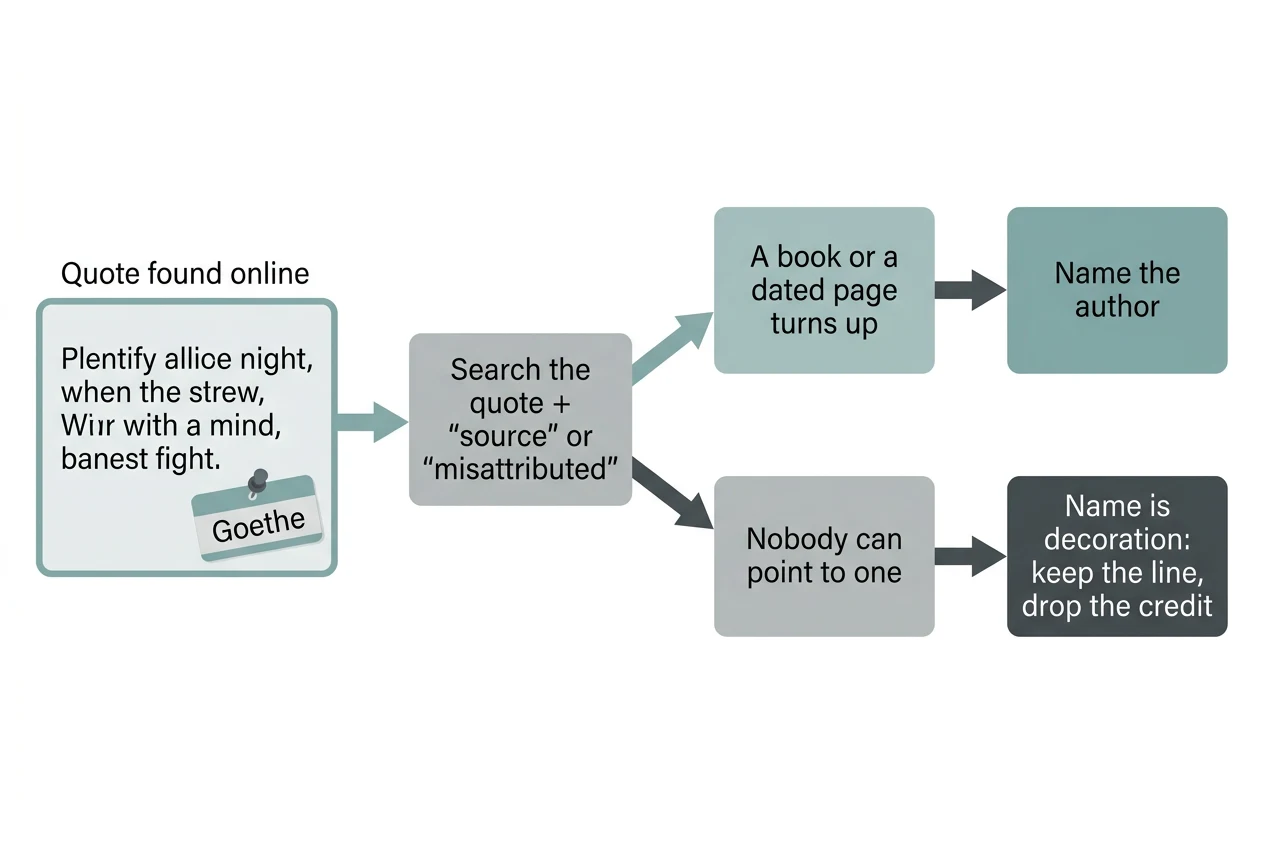
Murray's couplet, with its Goethe credit, is a good example of how far a line can travel from its owner. Check before you pin a name to it.
Search the quote with the word "source" or "misattributed" beside it. If nobody can point you to a book or a dated page, treat the name as decoration. The line may still be worth keeping. It just shouldn't be quoted as theirs.
How to use manifesting quotes every day
Here is a routine that takes about five minutes. Do it in the morning, before the phone gets loud.
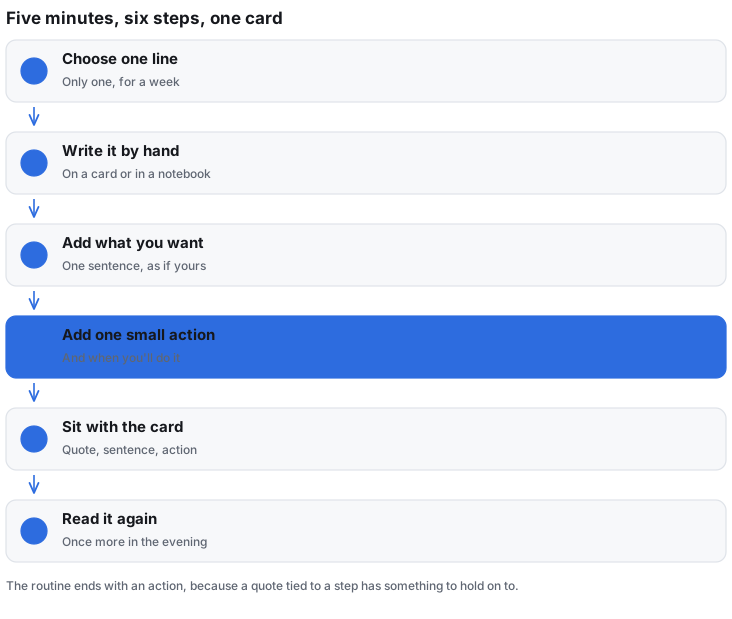
- Choose one line from above. Only one, for a week at least.
- Write it by hand on a card or in a notebook. Slow handwriting makes you stay with each word.
- Under it, write the one thing you want, in a sentence, as if it were yours.
- Under that, write one small action that fits the line, and when you'll do it. "When I finish lunch, I'll send the email."
- Sit with the card for a few minutes. Read the quote, then your sentence, then the action.
- Put the card where you'll see it, and read it once more in the evening.
The action matters. A quote read alone feels good and fades. A quote tied to a step you take that afternoon has something to hold on to. If you'd like to see why, begin with the end in mind walks through picturing the result and then choosing the step.
If you want company for step five, the meditate page on Manifest has a timer that starts at 3 minutes and keeps playing with the screen off. Others write the line out across the day, which is the 369 method. Pick whichever you'll still be doing in two weeks.
When you want calm more than momentum
Manifesting quotes tend to push forward. Some days you don't want a push, you want to be steady. The peace of mind quotes post collects lines for that mood, from Marcus Aurelius, Epictetus, Seneca and Philippians. Keep one of each kind, and use whichever fits the day.
What a quote can't do
It won't make anything arrive. Nothing here shows that repeating a sentence changes your luck or your bank balance, and I'd be wary of anyone who says it does, because a line on a card can only keep one intention in front of you long enough for you to act on it. That's all. It's plenty.
So pick the line that made you slightly uncomfortable, the one that points at something you've been putting off. Write it down tonight, and read it tomorrow morning.