Here are four peace of mind quotes that have lasted for centuries, with who said them, where they come from and what each one asks of you. Pick the one that feels true today and keep only that one.
In short: The best peace of mind quotes point inward: your thoughts, your fears, your own quiet place. Choose one line, write it by hand and sit with it for a few minutes.
Why a line of text can help at all
You have probably seen the pictures. A sunset, a cursive font, a line about calm. You scroll past, feel nothing and wonder what the fuss is about.
A quote does very little on its own. What it can do is give your mind something to hold when it's spinning. One short sentence is easier to carry than a whole philosophy, and that's the only job it has.
So the list is short. It's a few lines, checked against where they came from, because a lot of the quotes online are pinned on the wrong person. If you're going to keep a sentence close, it helps to know it's real.
Four peace of mind quotes, and where they come from
Each of these comes from an older text that you can still read today. The translations below are in the public domain, and each is credited.
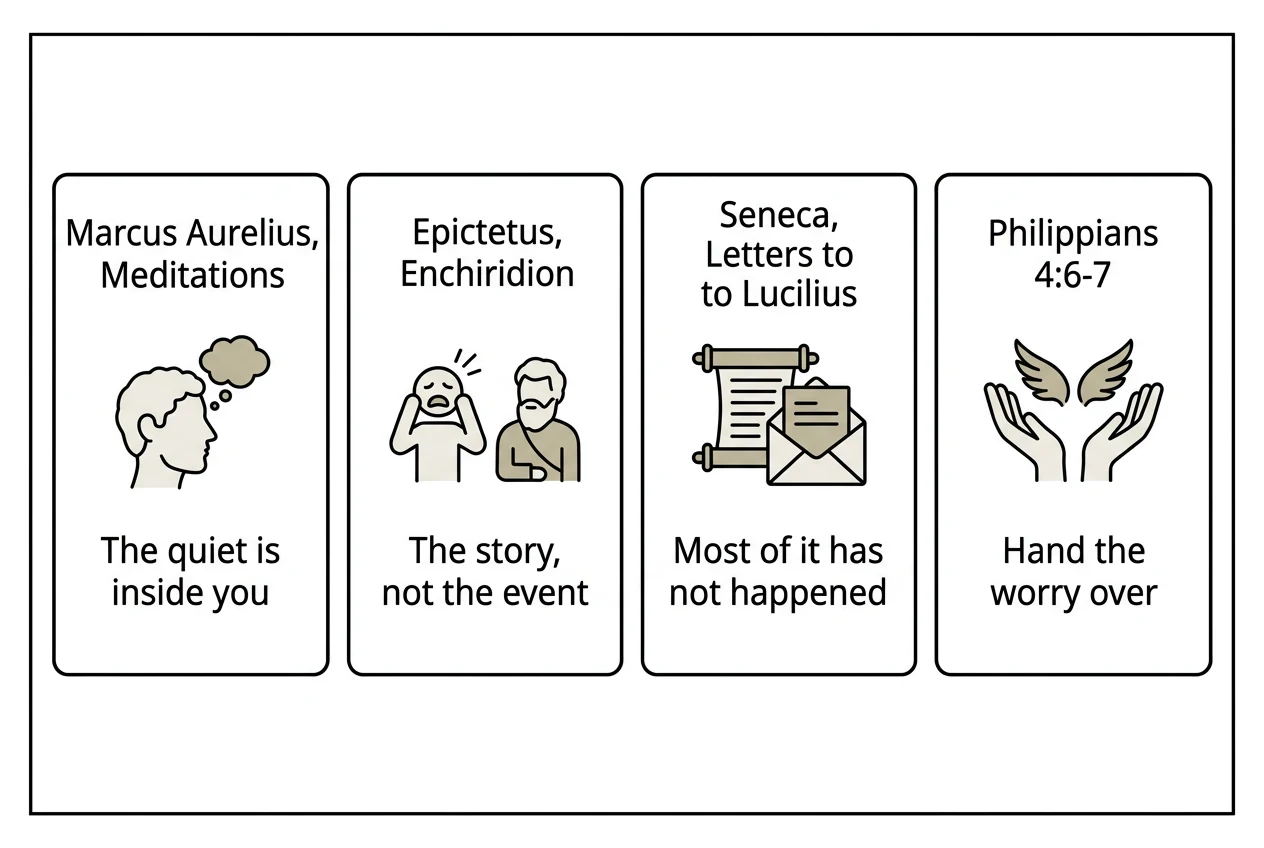
Marcus Aurelius: the quiet is already inside you
"For nowhere either with more quiet or more freedom from trouble does a man retire than into his own soul."
Marcus Aurelius, Meditations, Book Four, translated by George Long
Marcus Aurelius wrote this while he was Roman emperor, which is a job with no quiet in it, and what he's saying is that people go looking for a retreat, a cabin or a beach or a mountain, when the place they want is closer than that. You can read the passage in full in Long's translation of the Meditations.
What it asks of you: stop waiting for the right setting. A few minutes in a parked car counts.
Epictetus: it's the story, not the event
"Men are disturbed, not by things, but by the principles and notions which they form concerning things."
Epictetus, Enchiridion, section 5, translated by Elizabeth Carter
Epictetus gives the example of death. It isn't frightening in itself, he says, or Socrates would have found it so. The fear comes from the idea we hold about it. The full text is in Carter's translation of the Enchiridion.
Read it gently. It doesn't say your pain isn't real, and it doesn't tell you to feel fine. It points at the part you have a little say over: what you tell yourself about what happened.
What it asks of you: notice the story you're telling, and ask whether it's the only one.
Seneca: most of it hasn't happened
"We suffer more often in imagination than in reality."
Seneca, Letters to Lucilius, Letter 13, translated by Richard Mott Gummere
This is from a letter titled "On groundless fears". Seneca was writing to a friend about worry, and the point is plain enough to fit on a sticky note, because much of what keeps us awake is a picture of the future that isn't here yet. The letter is available in Gummere's translation on Wikisource.
It won't stop the picture from showing up. It can help you spot it when it does. If the worry is about the past and not the future, the post on how to let go of the past covers that side of it.
What it asks of you: when you're scared, ask what has actually happened so far, as opposed to what you're picturing.
Philippians: a peace you don't have to work out
"Do not be anxious about anything, but in everything by prayer and supplication…"
"…the peace of God, which surpasses all understanding, will guard your hearts and your minds in Christ Jesus."
Philippians 4:6-7, English Standard Version
This one is from the Bible, and it comes from a different place than the other three. It doesn't ask you to reason your way to calm. It describes a peace that arrives without your understanding how. It also names the mind specifically, which is why it shows up on so many lists of peace of mind quotes. You can read the verses in context on Bible Gateway.
You don't need to share the faith to see why it has comforted people for so long. If you do share it, it may be the one you want.
What it asks of you: hand the worry over, and don't hold the whole weight alone.
A note on quotes you find online
Some of the most shared lines about calm are credited to Buddha, Lao Tzu or Marcus Aurelius with no source at all, and while a few are real, many are paraphrases or were never said by the person named, which is why it pays to check before you pin one to your wall.
A quick check is to search for the quote with the word "source" or "misattributed" beside it. If nobody can point to a book, a letter or a translated text, treat the name as decoration. The line may still be worth keeping. It just shouldn't be quoted as theirs.
How to use a quote so it does something
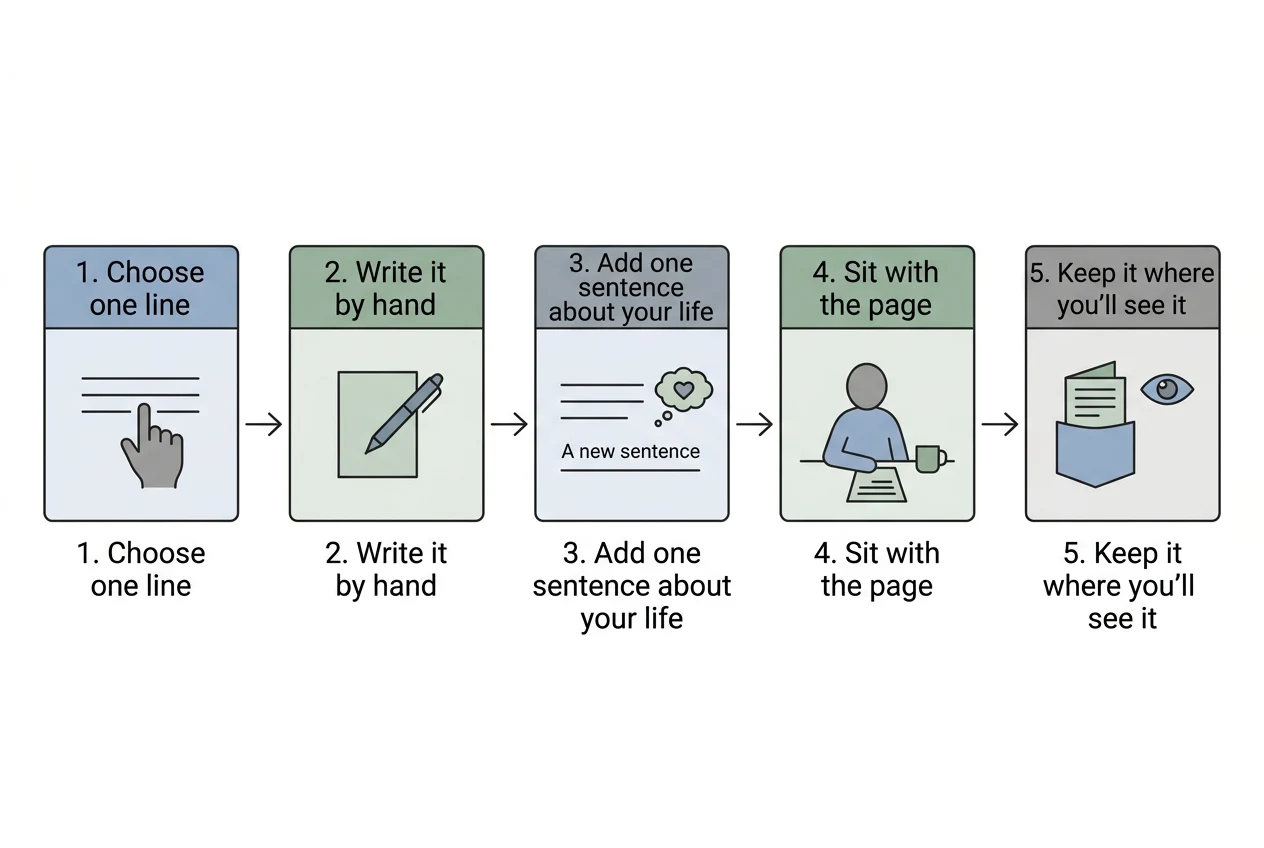
A quote on your wall is a nice thing to have. A quote you've used is better. Here is a way to try one that takes about ten minutes.
- Choose one line from above, or from somewhere else you trust. Only one.
- Write it out by hand. Slowly. It's a small thing, but handwriting makes you stay with each word.
- Under it, write one sentence about where it fits in your life right now. "I'm telling myself the meeting will go badly" is a good one.
- Sit with the page for a few minutes. Don't try to solve anything. Let the line and your sentence sit next to each other.
- Keep the page somewhere you'll see it, and read it when your mind starts to race.
If you'd like company for step four, the meditate page on Manifest has a timer that starts at 3 minutes, with a few background sounds if silence is too loud. It's a place to sit. It doesn't promise anything.
What a quote can't do
It can't fix the thing that's worrying you, and it won't replace sleep, food, a friend or a doctor. A small handrail, not a treatment.
If you'd like more than a line, the post on peace of mind when life goes off script has small steps for the days when everything feels shaky. And if the worry has hung around for weeks, or you can't do the things you used to do, please talk to someone trained to help, because a quote is a good companion but it isn't meant to carry that on its own.
Pick one line today. Write it down, and let it be enough for now.