Most mind tricks are party games. A few are real, small mental moves that studies have tested: an if-then plan, a different word for a nervous feeling, and talking to yourself by name. None of them is magic.
In short: Three mind tricks have decent research behind them: if-then plans, calling nerves excitement, and self-talk in the third person. They nudge you. They don't change what's true.
What people mean by mind tricks
Say the phrase and someone will do the Obi-Wan hand wave. Someone else will mention a card trick.
But most people typing it into a search box want something else. They want a move they can make in their own head, today, that makes a hard moment a little easier. Starting a task, or getting through a talk. Not spiralling at 11pm.
That kind of trick exists. It's modest, because it works on how you handle your attention and your words, not on the world.
The if-then plan
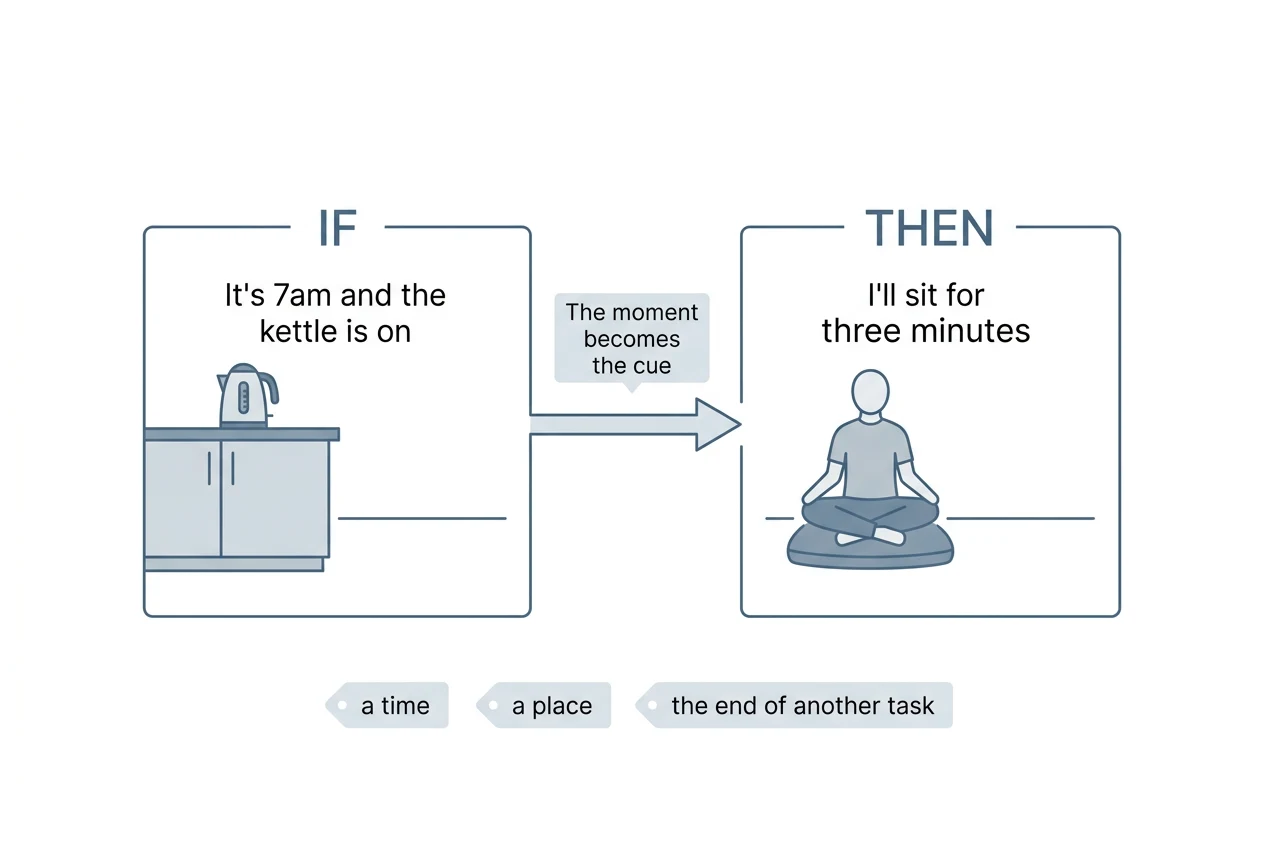
This one is the plainest. You decide in advance what you'll do when a certain moment arrives. Psychologists call it an implementation intention, which is a long name for a sentence shaped like this: If it's 7am and the kettle is on, then I'll sit for three minutes.
The moment becomes the cue. You don't have to decide or remember or feel like it, because the plan already has the decision in it.
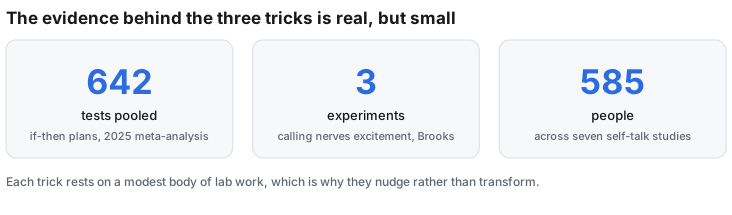
The research is bigger than for almost anything else on this page. A 2025 meta-analysis by Sheeran, Listrom and Gollwitzer pooled 642 tests of the technique, and it found that if-then plans helped across thoughts, feelings and behaviour, with effect sizes between .27 and .66. Plans worked better when they used the if-then format, when people were highly motivated, and when they rehearsed the plan.
Read that last part twice. The plan helps people who already want the thing. It isn't a way to make yourself want something.
To try it, write one sentence with a real cue in it: a time, a place, or the end of another task. Say it out loud once. That's the rehearsal.
Call the nerves excitement
You're about to speak, or sing, or sit an exam. Your heart is going. The usual advice is to calm down.
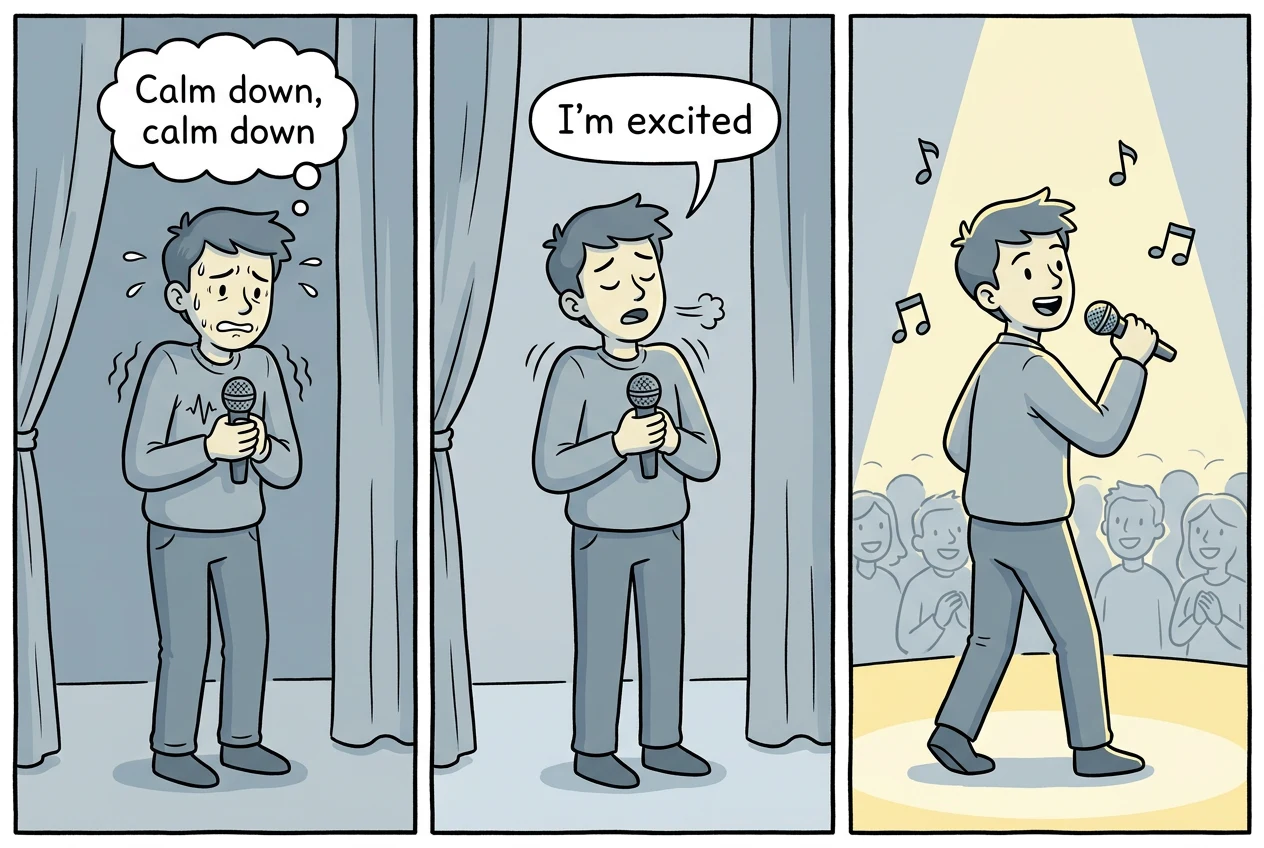
The researcher A. W. Brooks tested a different move. Across three experiments, people either said they were excited or tried to stay calm before a task, and the tasks were karaoke, a speech and a hard maths problem. As Harvard Magazine reported it, those who said they were excited sang better on an objective measure of pitch, rhythm and volume, and judges rated excited speakers as more persuasive and more confident. The full paper is Brooks (2014) in the Journal of Experimental Psychology: General.
The reasoning is neat. Anxiety and excitement are both high-energy states, so going from one to the other is a smaller step than going from racing to relaxed.
It's a reframe, not a cure. If the dread is about something real, the reframe won't remove it. But for plain stage fright, say it aloud: "I'm excited."
Talk to yourself like a friend would
When you're stuck on a worry, you probably say "I" a lot. Why did I say that. What am I going to do.
A 2014 paper by Ethan Kross and colleagues ran seven studies with 585 people in total. They found that using your own name, or "you", instead of "I" while thinking things through helped people step back from the feeling. In the stress studies, the task was giving a speech.
Try it on a small worry first. "Okay, Sam, what's actually going on here?" Name instead of pronoun. It feels silly for about a minute, and then it feels like advice from someone slightly calmer than you.
Where these tricks stop
Be a little suspicious of anything on this page, this page included. The studies are mostly short, run in labs, and a speech task in a lab isn't a job interview. Effects are modest, and the sources I've cited are summaries of research I haven't re-run myself.
None of it changes the world around you either. An if-then plan gets you to the cushion; it doesn't decide what the sitting does. Calling nerves excitement helps you sing. It doesn't make the audience like the song.
So treat them as tools for attention and habit. Small, cheap, and easy to test on yourself for a week. The same honest limits apply to the mind muscle connection, another attention trick, and to the subconscious mind, where plain habits turn out to matter more than clever lines.
If what you want help with is a busy head, the five-minute sit in how to quiet your mind pairs well with an if-then plan. Pick the cue, then sit. Start with one trick. Keep it if it helps.