If you want to know how to quiet your mind, the short answer is that you don't fight the noise. You give it somewhere to go, then give your attention one small thing to rest on. It takes a few minutes, and it works in degrees.
In short: Write the loud thoughts down, then sit for three to five minutes with one steady thing, like your breath or a sound. Expect a quieter mind, not an empty one.
Why your mind feels so loud
Some days it's a radio you can't turn off. A to-do list, a conversation from Tuesday, a worry about next month, all at once.
Nothing is broken. Minds wander. That's what they do when nothing is holding them. Researchers have found that the brain's "default mode" regions, the ones tied to wandering and self-talk, are less active in experienced meditators than in people who haven't practised. The same work points to stronger links in the parts that notice when you've drifted.
That finding compares two groups. It doesn't prove that sitting changes the brain. Still, it fits what most people notice. The noise doesn't vanish. You get quicker at spotting it.
So the aim isn't silence. The aim is to stop being dragged along by every thought.

Start by getting it out of your head
A mind that's holding twenty open loops can't settle. So empty it first.
Take a page, or a notes app, and write whatever is running. Don't tidy it. A list, a rant, half sentences. Two minutes is plenty.
There's some support for this at bedtime. In a 2018 sleep-lab study, 57 healthy adults aged 18 to 30 wrote either a to-do list or a list of what they'd already done. Those who wrote the to-do list fell asleep about 9 minutes faster on average.

It was a small study of young, healthy people, so treat it as a nudge and not a promise. But the idea is sound. A thought on paper no longer needs your head to keep it alive.
If what you can't stop thinking about is something from the past, the post on how to let go of the past covers a write-it-and-burn-it ritual.
How to quiet your mind in five minutes
Once the page is done, sit. You don't need a cushion or a special room.
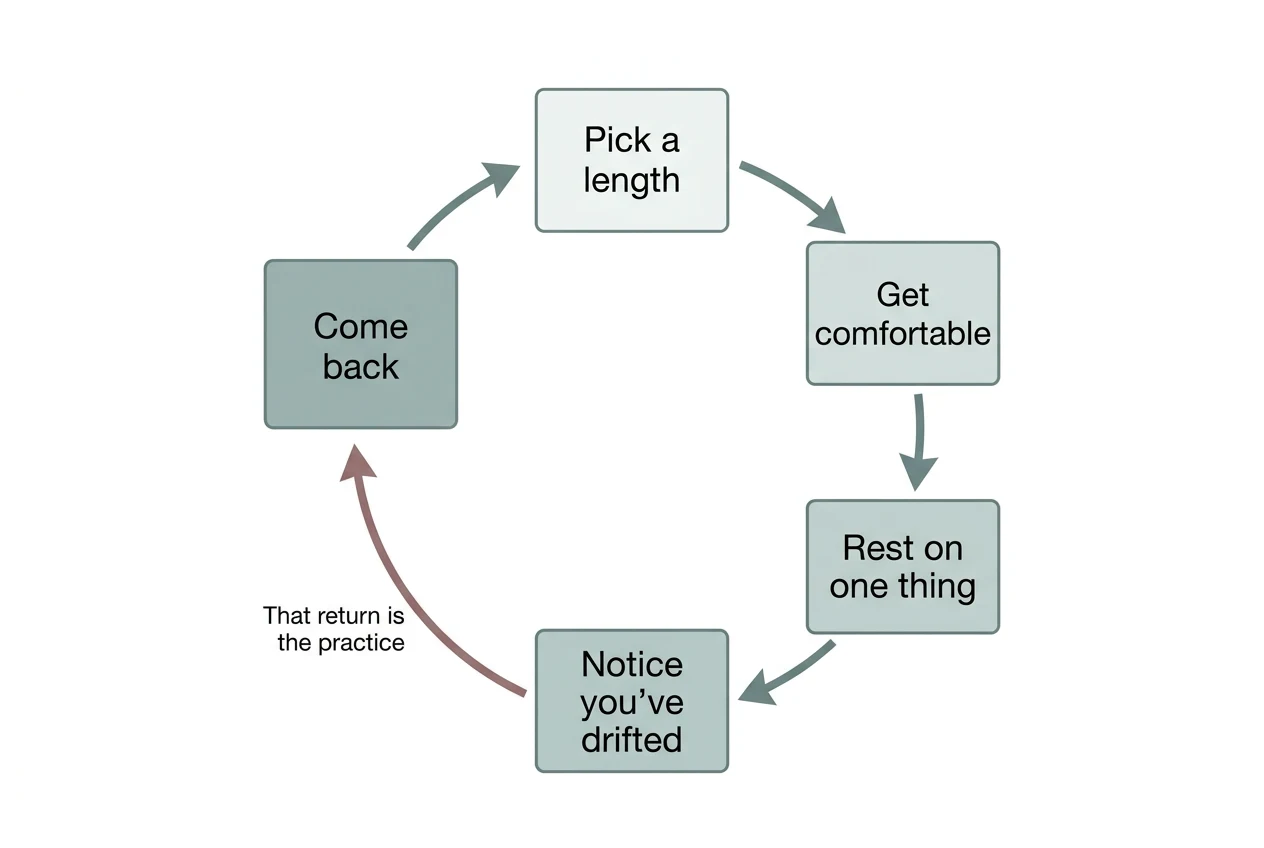
- Pick a length. Three minutes is enough to start. Five is better once it feels easy. Set a timer so you aren't checking the clock.
- Sit or lie down comfortably. Close your eyes, or rest them on the floor ahead of you.
- Choose one thing to rest on. Your breath at the nose or belly. Or a sound.
- Notice when you've drifted. You will. Within seconds, probably.
- Come back, without a telling-off. Say "thinking" to yourself and return to the breath. That return is the whole practice.
Most people believe the drifting means they're doing it wrong. It's the opposite. Each time you notice and come back, that's one repetition, like a lift at the gym.
Manifest's meditate page is built for this. It has timers of 3, 5, 10, 15, 20 and 30 minutes, and it keeps playing with the screen off, so you can set it and put the phone down.
Pick a sound that does some of the work
A steady sound gives a restless mind an easy place to land. Manifest offers five:
- Low hum. A dark drone, almost under hearing. It disappears after a minute.
- Bowl. A singing bowl struck every few seconds, at 528Hz.
- Rain. Hiss and separate drops. Good for covering a noisy room.
- Ocean. Slow waves rolling in and back out, about six seconds each.
- Silence. Just the timer and the bell.
Nothing here says one is better than another. Choose the one that bothers you least. If your room is loud, try rain. If you like a rhythm to follow, try ocean, where each wave gives you a natural breath to match.
When it's late and you can't switch off
Night is when the noise is loudest, because nothing else is competing for your attention.
Do the page first. Then set a sound before you lie down, and leave the screen alone. Don't treat it as a test of whether you fall asleep. Listening is enough, and if you drift off, that's fine.
What to expect, honestly
A quieter mind comes in small amounts. Some sessions will feel calm. Some will feel like a crowded train station. Both count.
A few things help:
- Short and regular beats long and rare. Three minutes a day is easier to keep than thirty minutes on Sunday.
- Same time, same place. Tying it to something you already do, like the first coffee, helps it stick.
- Count the return, not the quiet. If you came back ten times, you practised ten times.
This is a practice, not a cure. It won't fix a hard week, and nobody can promise you a particular feeling. But it gives you a way to step out of the stream for a few minutes, which is often enough to choose your next move. If the noise comes from life going off plan, the post on peace of mind when life is unexpected is a good next read, and a single line from these peace of mind quotes can be something to rest on during a sit.
When noise is more than noise
If your thoughts race for days, if they keep you from sleeping most nights, or if they come with dread you can't explain, that's worth taking to a doctor or therapist. A timer and a page are good company for that work. They aren't a stand-in for it.
For today: write it down, set three minutes, and rest on one thing. Come back as often as you wander.