The mind muscle connection is the habit of putting your attention on the muscle you are training, and feeling it work, instead of just moving the weight. A little research says it can help muscle grow, mostly with lighter loads and simple exercises.
In short: Think about squeezing the target muscle through each rep. It seems to help most at moderate weight and on single-joint moves like curls. It matters less when the bar is near your limit.
What the mind muscle connection means
Ask ten lifters and you'll get ten answers. Most come down to this: during a curl, you picture your biceps shortening and feel it do the pulling. You don't think about the dumbbell going up.
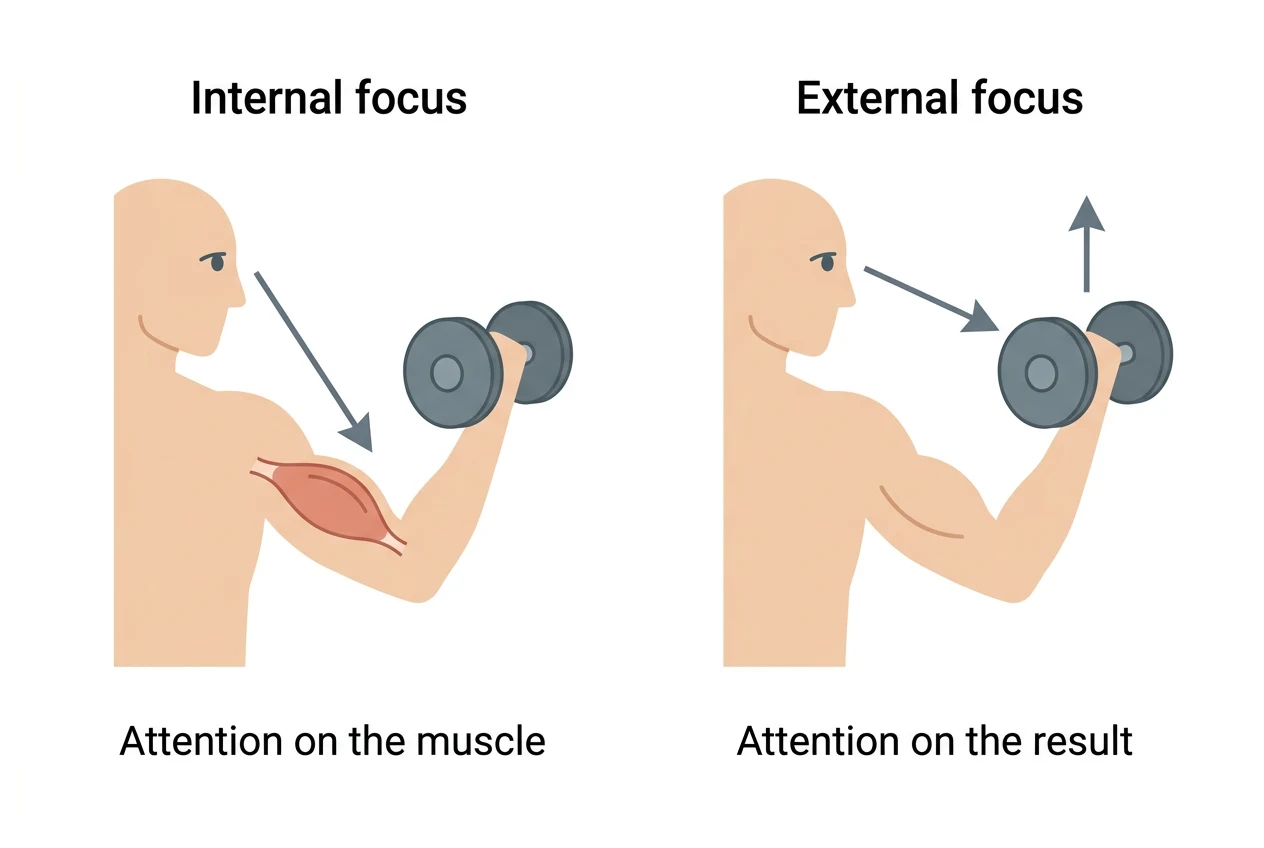
Researchers call this an internal focus, attention on the body. The alternative is an external focus, attention on the result of the move, like pushing the floor away or getting the bar to the ceiling.
Neither is mystical. It is attention, pointed at one place, and the open question is whether pointing it there changes what your muscles do once the set gets hard, because a thought can only help if it changes how much of the muscle you actually use.
What the research shows
The best-known test is an eight-week trial from 2018. Thirty untrained young men did the same training three times a week. One group focused on contracting the target muscle. The other focused on lifting the weight.
The group that thought about the muscle gained about 12.4% in elbow flexor thickness. The other group gained about 6.9%. Quadriceps growth was similar in both groups, and the strength gains didn't differ enough to count.
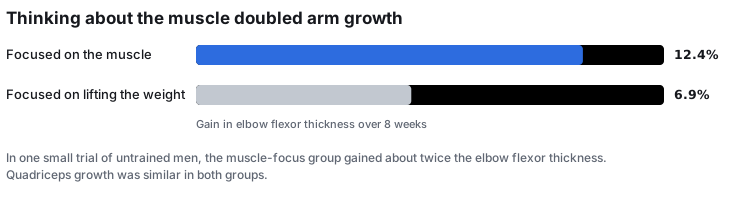
Small study. Beginners only. Don't read it as a law. The authors suggested that people may simply have finer control over arm muscles than leg muscles, which would explain the gap.
Other work points the same way on muscle activity. A 2016 bench press study, as described in secondary sources, found that thinking about the chest raised chest activation at lighter loads, roughly 20 to 60% of your one-rep maximum. At 80% the effect disappeared. I couldn't read that paper itself, so treat the exact numbers as approximate.
Strength is a different story. A 2021 meta-analysis of attentional focus and strength looked at the long-term effect, and as reported it found no meaningful difference between internal and external focus for strength gains. For lifting heavy, looking outward may be the better habit.
When it helps, and when to let it go
Putting this together, a fair summary:
- It helps most on isolation moves (curls, raises, extensions), with moderate weight, when your goal is size.
- It helps less on heavy compound lifts, where a clear outward cue like "drive the floor away" tends to work better.
- It fades near maximal effort. When the bar is that heavy, your attention goes to survival, and that's fine.
So the mind muscle connection is a tool for certain sets, not a rule for every one.
How to build the mind muscle connection
You don't get it by wanting it. You get it by practising attention, in small doses.
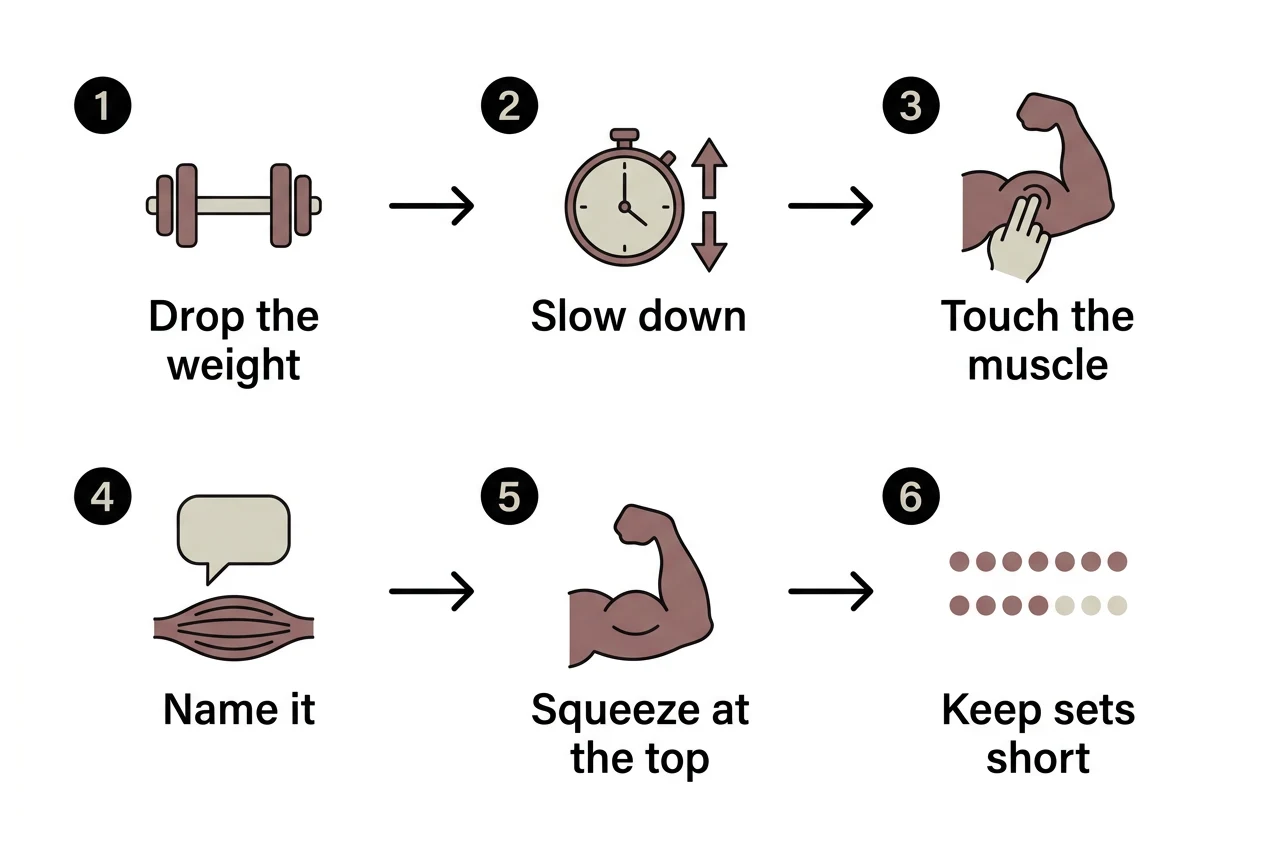
- Drop the weight. Use a load you could lift for 15 reps. It's hard to feel a muscle you're straining to survive.
- Slow down. Take about two seconds up and two or three down. Speed hides the feeling.
- Touch the muscle. Lightly press your fingers on it between sets, then again during a rep. It gives your attention an address.
- Name it. Before each set, say which muscle you want to feel working. Then track it for the whole set.
- Squeeze at the top. A brief pause at the hardest point gives you something clear to notice.
- Keep sets short. Attention drifts. Stop when you lose the feeling, not long after.
Expect it to feel odd at first. Back and leg muscles are harder to feel than biceps, and that's normal.
A skill that isn't only for the gym
What you're really training here is the ability to hold your attention on one thing, notice when it slips, and return. It is the same move as sitting with a breath or a sound. If you already practise that, the five-minute sit in how to quiet your mind is the same skill with no weights.
A short sit before training can be a reasonable warm-up for it. That's a suggestion, not a finding. I'm not aware of research showing it improves lifting.
Honest limits
The evidence is small. Most of it is short studies of untrained men, measured at a few muscles. It doesn't show that focus beats good programming, enough protein, sleep or effort. Those matter more.
Try it on your lighter, size-focused sets for a few weeks. If you feel the muscle work more, keep it. If it distracts you on your heavy lifts, drop it there. Pay attention to the muscle, then do the next rep.