The secrets of the millionaire mind, in T. Harv Eker's book of the same name, come down to one claim: what you believe about money was set early, and it quietly steers what you do with it. The book calls that setting your "money blueprint." You can look at yours. You can't promise what happens next.
In short: The book says your habits with money follow a blueprint you picked up as a child. The useful part is noticing yours. Treat the rest as ideas to test, not guarantees.
The secrets of the millionaire mind, in the book's terms
Secrets of the Millionaire Mind is by T. Harv Eker, a Canadian entrepreneur and speaker who founded Peak Potentials Training. Its subtitle is "Mastering the Inner Game of Wealth."
The argument is plain. Money has an outer game, the tools and tactics, and an inner game, which is the thoughts and feelings you carry about it. Eker puts most of the weight on the inner one.
He is selling a way of looking, not a formula, because summaries of the book note that it has no investment formulas and no promised returns, and that's worth holding onto as you read on.

The money blueprint
The blueprint is the book's central idea. It is a script, mostly out of sight, that shapes how you think and act around money, and how you feel while you do it.
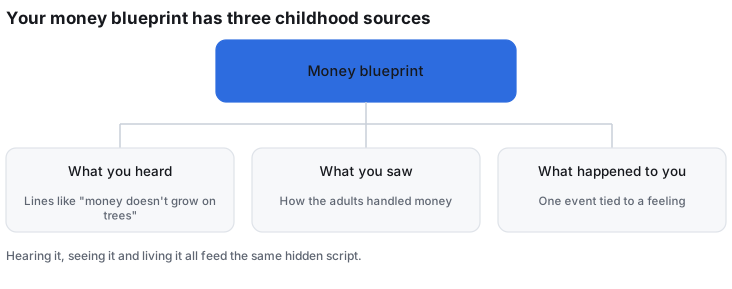
Where does it come from? Summaries of the book name three sources in childhood:
- What you heard. Lines like "money doesn't grow on trees," repeated until they felt like facts.
- What you saw. How the adults around you handled money. Tight, generous, anxious, secretive.
- What happened to you. One event, like a hard stretch in the family, that tied money to a feeling.
You may not agree with all of it. Test it anyway. Think of the first money sentence you remember, then ask who said it and whether you still believe it, because that one memory is all the test needs.
The financial thermostat
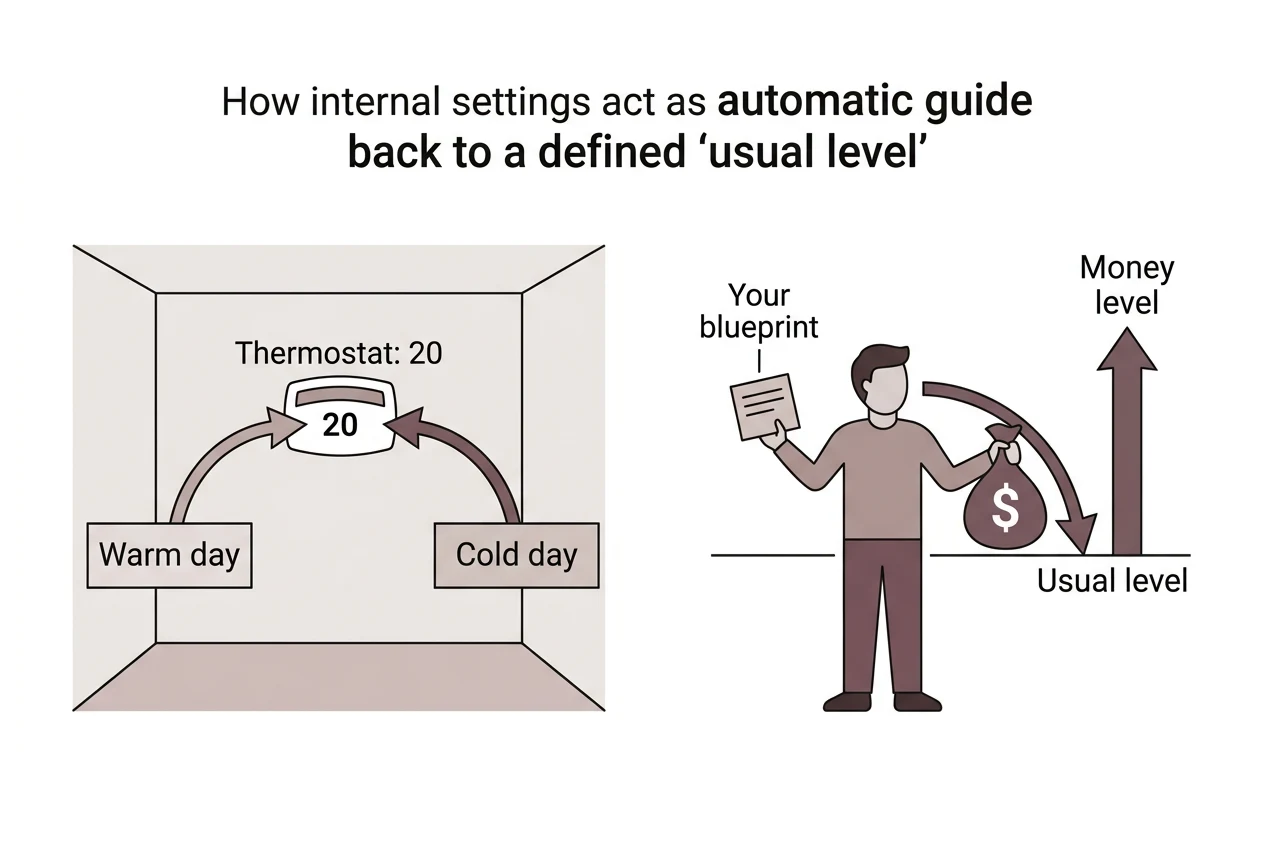
Eker's best-known image is a thermostat. Set a room to 20 degrees and it pulls the temperature back to 20, warm day or cold. In the book, your blueprint does the same with money, so if you drift above your usual level, you pull yourself back, the way the room settles at 20 whatever the weather does.
He points to lottery winners who lose it all, and to self-made people who go broke and rebuild. It's a vivid story. It is also an illustration, not a finding. I haven't checked those examples against the research, so hold them lightly.
What survives is the question. Is there a number, or a feeling, where you start to get uneasy? Some people feel it at a raise. Others feel it when a bank balance gets "too" high. Noticing that discomfort costs nothing.
The wealth files
The book also lists what it calls wealth files: pairs of thoughts, one "rich" and one "poor." One example in the summaries is that the rich think "both" and the poor think "either/or." Another is that the rich get paid for results and the poor get paid for time.
Be careful here. These are generalisations and some are unkind to people with less money, and money often comes down to luck and health, and to where you were born and who you knew, which no belief cancels.
I couldn't find an authoritative list of all of them in the sources I read, so I won't recite one. Read the book if you want the full set.
A way to find your own blueprint
You don't need the book for this part. It takes ten minutes.
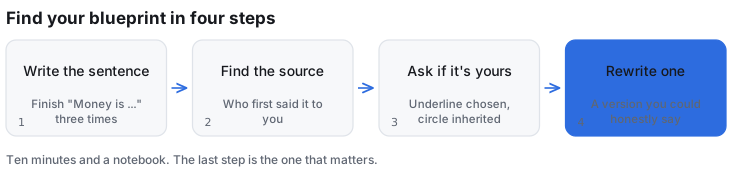
- Write the sentence. Finish this line: "Money is ..." Don't edit. Write three endings.
- Find the source. Next to each, write who you first heard it from.
- Ask if it's yours. Underline the ones you chose. Circle the ones you inherited.
- Rewrite one. Pick a circled belief and write a version you could honestly say. Not "I'm a millionaire." Something closer to true, like "I can learn how money works."
That last step matters, because a line you don't believe just starts an argument in your head, and that's a poor thing to carry into a quiet sit.
Where this fits with manifesting
This site is about calling one thing in. Eker's book gives that a practical edge: before you ask for something, see what you quietly believe about having it.
Sit with the rewritten line. Manifest's meditate page has timers from 3 to 30 minutes and keeps playing with the screen off, so you can set a sound, read your sentence once, slowly, and then let it be. If your list is full of old worries, the post on how to let go of the past offers a write-it-and-burn-it ritual.
What to keep, and what to leave
Keep these:
- Beliefs about money are learned. That's a fair, useful thing to know.
- Noticing beats arguing. You can see a belief without obeying it.
- Small, honest rewrites. They beat grand declarations.
Leave these, unless you can check them for yourself:
- Any promise of a result. Reading a book, or writing a line, will not make money arrive.
- The idea that mindset is the whole story. It isn't. Income and costs matter, and so does chance.
- Tidy "rich versus poor" rules. Real lives are messier.
If money worry is keeping you up, or you are in debt you can't see a way out of, talk to a qualified adviser or a free debt-advice service. A notebook is good company. It isn't a plan.
For today: write "Money is ..." three times, and read what you wrote.