Knowing how to change your mind comes down to two skills: noticing when your reasons have stopped holding, and deciding on a date, not a mood. This post covers both, and the books that go deeper, with where to buy them.
In short: Ask how sure you are, from 0 to 100. Write down what would change your answer before you need it. Then decide when a short list of conditions is met, not when the feeling is loudest.
Is "How to Change Your Mind" a book?
Yes. It's worth clearing up, because the title sends some people the wrong way.
How to Change Your Mind is a book by Michael Pollan, first published in May 2018 by Penguin Press. Its full title is How to Change Your Mind: What the New Science of Psychedelics Teaches Us About Consciousness, Dying, Addiction, Depression, and Transcendence. It is not a self-help guide to making up your mind. It's about psychedelic drugs, and it's a good book on that subject.
Pollan traces the history of psychedelics from their 1960s heyday, through the backlash, to the recent revival in research. He also writes about his own experiences, which he treats as a kind of travelogue. The book has six chapters and an epilogue, and it moves from history to neuroscience and then to the use of these drugs in therapy, which helped it become a No. 1 New York Times best-seller.
The title is a pun of sorts. Pollan wants to know how a mind that has run in the same grooves for decades might be shaken loose. Came here for a method to change a belief or a plan? Wrong book. Curious about consciousness? Strong read.
You can buy it at Penguin Random House, which lists hardcover, paperback, large print, ebook and audiobook editions. Most bookshops sell it too.
Two books that answer the real question
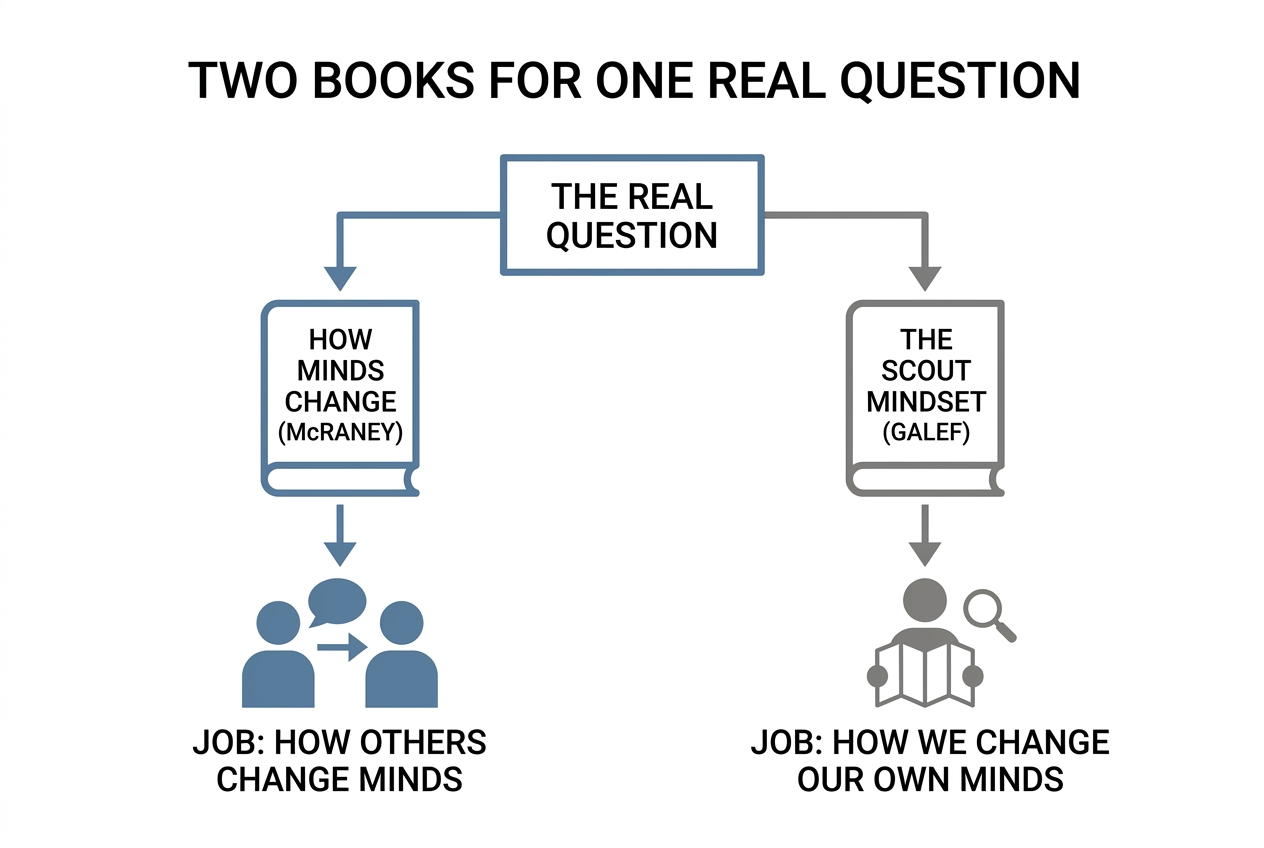
If your question is how to actually change your mind, two other books are closer to what you want.
How Minds Change by David McRaney (Portfolio, June 2022, 352 pages). The subtitle is The Surprising Science of Belief, Opinion, and Persuasion. McRaney began it as a book about changing someone else's mind, but then a 9/11 Truther changed his own, and the question turned inward: why do we believe what we believe? The book follows cult members and conspiracy theorists, plus political canvassers. It leans on two methods, deep canvassing and street epistemology, both built on listening and on asking people to look at their own reasons. One reviewer notes it's a survey of stories and research, not a step-by-step manual.
The Scout Mindset by Julia Galef (Portfolio, April 2021, 288 pages). Galef splits thinking into two stances. The soldier defends a position. The scout wants an accurate map, even when the map is unwelcome. Her claim is that scouts aren't smarter, they just have habits and emotional skills that anyone can learn, such as holding opinions loosely and putting a number on your confidence.
Both are on the Penguin Random House site, and both are easy to find at any bookshop. Read McRaney if you want to understand why minds resist. Read Galef if you want a stance to practise.
How to change your mind, step by step
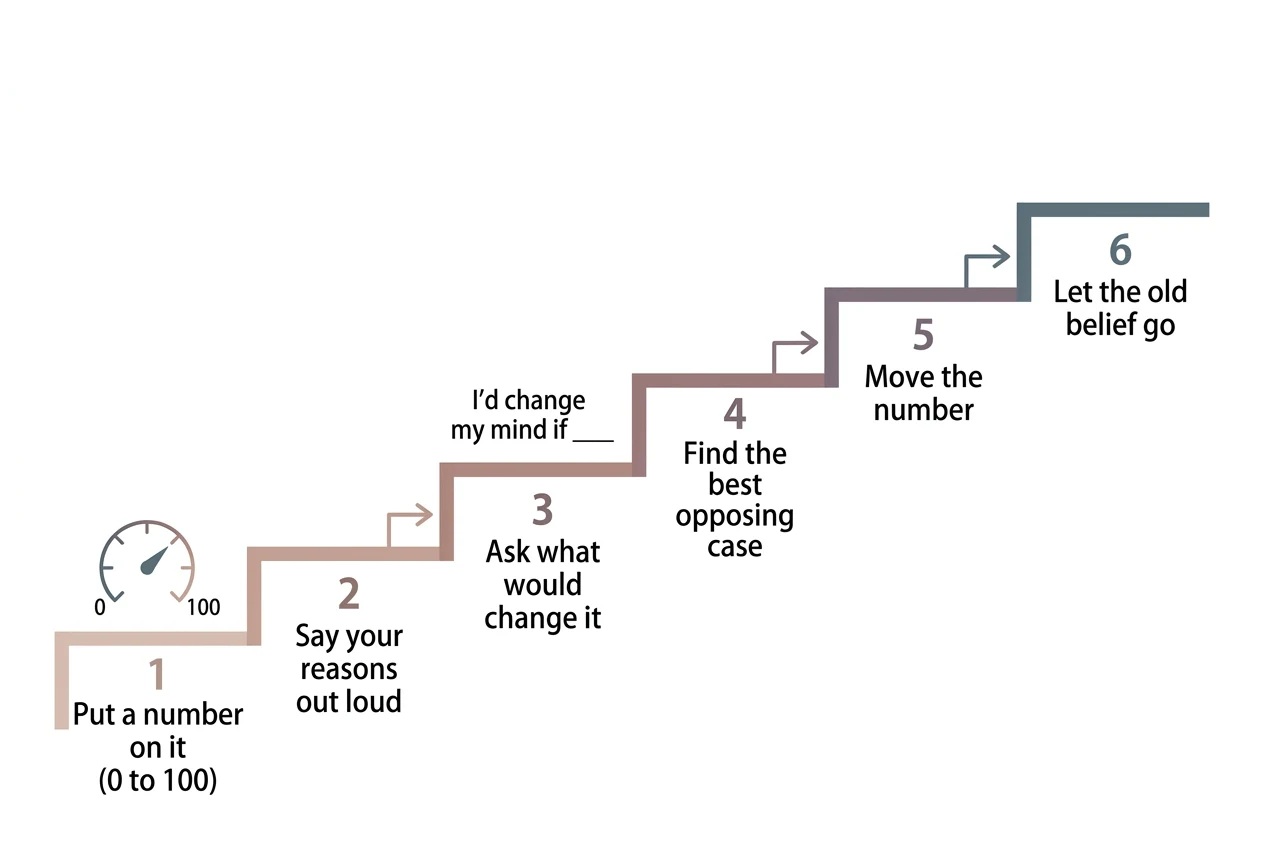
Here's a method pulled from those books and from plain good sense. It's small on purpose.
- Put a number on it. How sure are you, from 0 to 100? McRaney describes this question as a recurring tactic in street epistemology, and few people say 100, while many shift their estimate once they talk it through. A number gives you something to move.
- Say your reasons out loud. Explain the belief in detail, to a friend or on paper. The book suggests that when people are asked to explain an issue in detail, their opinions often become less extreme. You find the gaps by trying to fill them.
- Ask what would change it. Finish this sentence: "I'd change my mind if I learned ___." Can't finish it? Then you may be holding the belief for comfort, not for evidence.
- Look for the best opposing case. Not the silliest version. The strongest one, as its own supporters would put it.
- Move the number. Even by five points. A mind changes in small steps far more often than in one leap.
- Let the old belief go on purpose. If it's tied to who you thought you were, that part takes longer, and the post on how to let go of the past is a practical way to do it.
When to take a decision
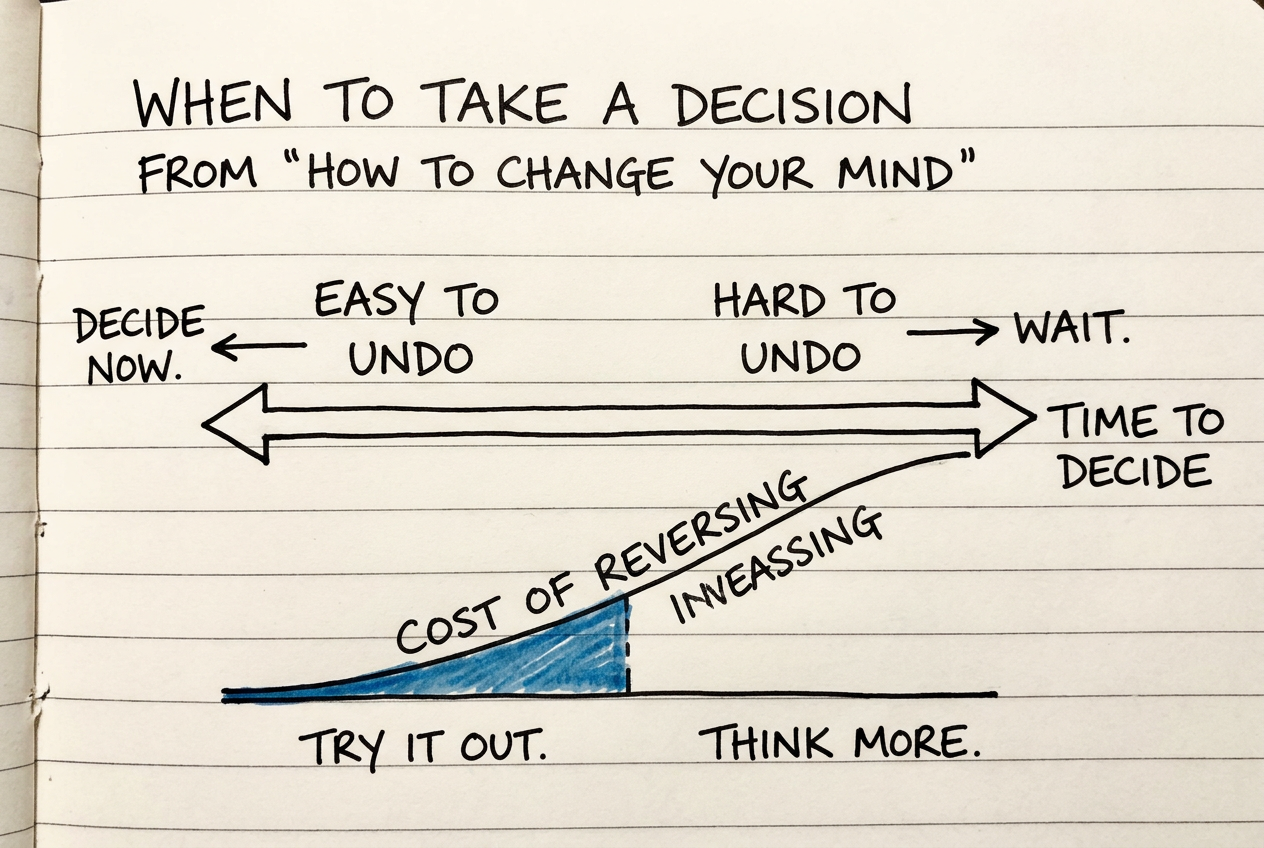
Changing your mind and making a decision are different acts, and mixing them up causes most of the pain. You can change your mind in a minute. Acting on it should wait for the right moment.
Annie Duke's book Quit: The Power of Knowing When to Walk Away (2022) gives the cleanest tool for this: kill criteria. Before you start a project or a job, you write down what future facts would mean it's no longer worth it, and then you agree with yourself to walk away if they show up. Her standard example is the turnaround time on Everest. Each summit day has a fixed hour at which climbers turn back, whatever they feel at that point.
Why does it work? People are poor at spotting the moment to quit while they're inside the thing, because sunk cost pulls the other way, and so does the wish for certainty, and plain habit does too. A rule written when you were calm does the work for you when you aren't.
One critic of the book argues that this logic fits badly with personal life, where your priorities can change as you learn and grow. That's fair. Use kill criteria for things with a clear test, such as money and deadlines, but for relationships and big life questions, treat them as prompts to review, not as automatic triggers.
A few simple rules for timing:
- Decide now if it's easy to undo. If you can reverse the choice cheaply, a rough decision today beats a perfect one next month. Try it, and watch what happens.
- Wait if it's hard to undo. Give it a set period, such as a week or a month, and write down what you expect. Then compare.
- Don't decide in the heat. Anger and panic make a bad time, and so does a rush of excitement. Sleep on it, once.
- Set a review date. Put one in the calendar. "I'll look at this again on the first of next month" stops the question from circling in your head every day.
- Count the cost of waiting. Not deciding is a decision too, and it has a price. Name it.
When your mind keeps going back and forth
Sometimes you've changed your mind five times this week and none of the answers feels settled. A few things tend to be going on.
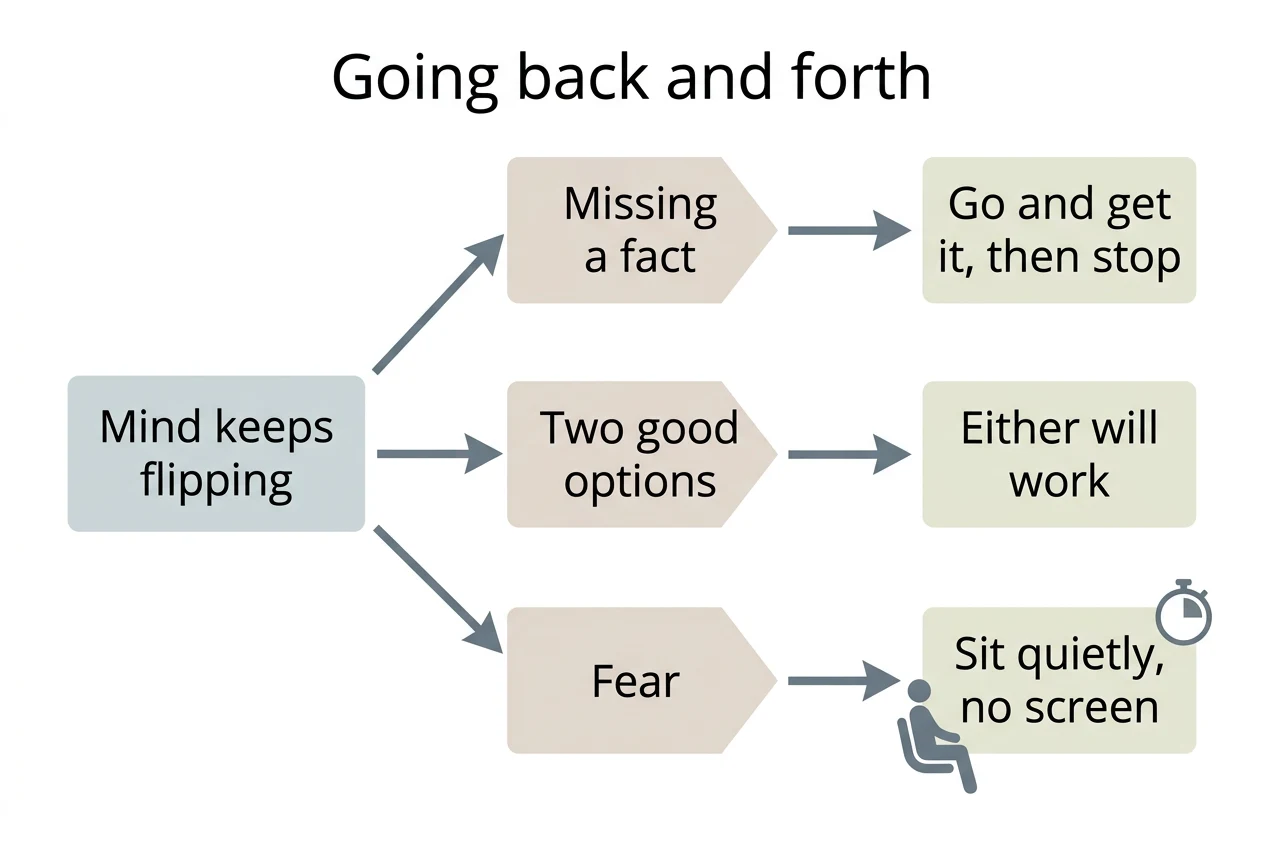
You might lack a fact. Go and get it, then stop. Or you're weighing two good options, in which case the difference between them is often smaller than it feels, and either will work. Or you're afraid, and the fear is making the choice look bigger than it is.
In that last case, quiet helps more than analysis. Sit for a few minutes with one question and no screen. The meditate page has a timer and a few sounds, and it keeps playing with the screen off. Nothing has to be solved while you sit, because you're only giving the noise time to settle so you can hear what you already think.
If the question underneath is "who will I be if I give this up?", that's worth writing down. The post on the power of your subconscious mind looks at why the stories we repeat to ourselves are so sticky, and what repeating a different one can and can't do.
A short list to keep
- Give your belief a number from 0 to 100.
- Write what would change it.
- Seek the strongest opposing view.
- Decide quickly when you can undo it, slowly when you can't.
- Set a review date, and keep it.
You are allowed to change your mind. Doing it well isn't weakness, because it means your beliefs are tracking something real. Pick one belief today that you hold a little too tightly, put a number on it, and write the sentence that begins "I'd change my mind if".